


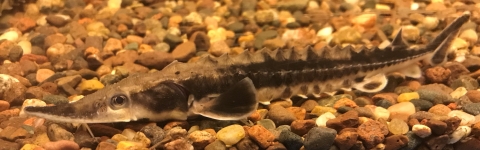
We put fish first as we safeguard the exceptional values of our treasured Great Lakes. We are one of 20 regional partnerships across the country with a primary focus on restoring our nation’s flagship fisheries. As we work together to bring our finned friends back to health – from legendary lake trout and lake sturgeon to iconic whitefish and walleye – our efforts contribute to clean water and a healthy environment for everyone.
Restoring our iconic Great Lakes fisheries
Carved out by receding glaciers thousands of years ago, the five massive, majestic lakes making up the Great Lakes are unparalleled natural wonders. The watershed encompassing Lakes Superior, Michigan, Huron, Erie and Ontario – each with its own unique features – covers about 300,000 square miles, including parts of eight states and two Canadian provinces. In addition to all the immeasurable, indescribable values, here are just a few things that make the Great Lakes special:
- First of all, the Great Lakes are home to nearly 150 native fish species!
- The Great Lakes support a $6 trillion regional economy, including commercial, recreational and tribal fisheries collectively valued at more than $5.1 billion annually.
- The Great Lakes have about 10,000 miles of shoreline, more than 3 times as much as the U.S. Pacific Coast, including prime habitat for many other kinds of wildlife, especially birds.
- The Great Lakes are the world’s largest source of surface freshwater and serve as a drinking water source for about 40 million people.
- The grandeur of the Great Lakes lures more than 100 million visitors every year.
Our nation’s fisheries have always been key barometers of environmental health. Like so many other naturally bountiful areas, the Great Lakes became imperiled over time from the impacts of the region’s growing population and natural resource uses that were harmful or non-sustainable.
Some of the main environmental threats in the Great Lakes continue to be toxic dumping and other water quality issues, habitat fragmentation and degradation, overfishing and invasive species invasive species
An invasive species is any plant or animal that has spread or been introduced into a new area where they are, or could, cause harm to the environment, economy, or human, animal, or plant health. Their unwelcome presence can destroy ecosystems and cost millions of dollars.
Learn more about invasive species that proliferate and disrupt the food web. It takes time, commitment and collaboration to repair the damage to our fisheries – and that’s where the Great Lakes Basin Fish Habitat Partnership makes a difference.
When our partnership was formed, we didn’t start from scratch – after all, the Great Lakes boast some of the most longstanding, well-coordinated conservation networks anywhere. We leverage the expertise and resources of existing community partnerships to create broader benefits for fisheries and fill in gaps where unfulfilled needs can be addressed.

Key species include
History
For 20 years, the National Fish Habitat Partnership initiative has united a network of 20 regional partnerships, including the Great Lakes Basin Fish Habitat Partnership. These partnerships bring together state, federal, tribal, academic and non-profit partners in strategic locations to address shared fisheries conservation challenges – and create opportunities to make more progress together.
When these efforts were codified in law through The America's Conservation Enhancement Reauthorization Act of 2024, it represented an unprecedented attempt to address an unseen crisis for fish nationwide: loss and degradation of their watery homes. The mission of this nationwide effort is to protect, restore and enhance the nation’s fish and aquatic communities through partnerships that foster fish habitat conservation and improve the quality of life for the American people.
The Great Lakes Fish Habitat Partnership benefits tremendously from the Great Lakes Restoration Initiative, which has provided 100% of the federal contribution to our on-the-ground project dollars to date. Led by the U.S. Environmental Protection Agency, the Great Lakes Restoration Initiative is a regional investment strategy targeting the most significant threats to our natural resources and accelerating environmental protection and restoration.
Projects
In 2025, we announced a total investment of nearly $400,000 to launch four projects in tributaries of Lakes Huron, Michigan, Ontario and Superior to improve habitat and conduct research for the benefit of brook trout and other native species. These four projects received federal grant funding of more than $163,000 and technical assistance valued at more than $70,000, matched by nearly $165,000 from community partners.
- Lake Huron / State of Michigan: Led by Miami University of Ohio, this project involves research on habitat connectivity in the Cheboygan River watershed. This project will investigate how river fragmentation affects genetic diversity in brook trout populations and evaluate the effects of efforts over 20 years to improve fish passage fish passage
Fish passage is the ability of fish or other aquatic species to move freely throughout their life to find food, reproduce, and complete their natural migration cycles. Millions of barriers to fish passage across the country are fragmenting habitat and leading to species declines. The U.S. Fish and Wildlife Service's National Fish Passage Program is working to reconnect watersheds to benefit both wildlife and people.
Learn more about fish passage . - Lake Michigan / State of Michigan: Led by The Conservation Resource Alliance, this project involves several activities to enhance habitat on the Little South Branch Pere Marquette River for brook trout, other wild salmonids and native, non-game fish species.
- Lake Ontario / State of New York: Led by Trout Unlimited, this project will restore habitat for brook trout and other native species on Trout Brook and Black Creek. This will involve riparian riparian
Definition of riparian habitat or riparian areas.
Learn more about riparian plantings to improve water quality and stabilize streambanks, creating sites for brook trout to feed, find shelter, grow and reproduce. - Lake Superior / States of Michigan and Wisconsin: Led by Trout Unlimited, this project involves adding large, woody debris to stabilize streambanks, support natural stream function and create habitat for brook trout and other native species on the Pilgrim River in Michigan and the Little Bois Brule River in Wisconsin.

Steering Committee
Amanda Kunzmann, Regional Fisheries Program Manager, U.S. Forest Service, Eastern Region
Nichol DeMol, Great Lakes Habitat Program Manager, Rogue River Home Rivers Initiative Project Manager, Trout Unlimited
Rebecca Redman, Project Specialist, Lake Michigan Program, Illinois Department of Natural Resources
Matt Herbert, Senior Conservation Scientist, The Nature Conservancy Michigan Office
Paul Piszczek, Senior Fisheries Biologist – Lake Superior Basin Tributaries, Wisconsin Department of Natural Resources
Cory Goldsworthy, Lake Superior Area Fisheries Supervisor, Division of Fish & Wildlife, Minnesota Department of Natural Resources
Christopher Legard, Aquatic Biologist, Lake Ontario Unit Leader, New York State Department of Environmental Conservation
Jessica Mistak, Supervisor, Habitat Management Unit, Fisheries Division, Michigan Department of Natural Resources
Brett Fessell, Restoration Section Leader / River Ecologist, Grand Traverse Band of Ottawa and Chippewa Indians, Natural Resources Department
Jeff Tyson, Fishery Management Program Manager, Great Lakes Fishery Commission
Eric Weimer, Fishery Biologist Supervisor, Sandusky Fisheries Research Station, Ohio Department of Natural Resources
Jessica Collier, Great Lakes Coastal Restoration and Partnership Coordinator, U.S. Fish and Wildlife Service Midwest Region
Susan Wells, Project Leader, Green Bay Fish and Wildlife Conservation Office, U.S. Fish and Wildlife Service
U.S. Fish and Wildlife Service support staff:
Thomas Hoffman, Aquatic Habitat Restoration Group Leader, Lower Great Lakes Fish and Wildlife Conservation Office, U.S. Fish and Wildlife Service
Pat Opay, Partnership and Habitat Branch Lead, Green Bay Fish and Wildlife Conservation Office, U.S. Fish and Wildlife Service
Shanice Jones, Regional Coordinator, National Fish Habitat Partnerships, Midwest Region Fish and Aquatic Conservation Program, U.S. Fish and Wildlife Service
Jessica Hogrefe, Program Supervisor, Fish and Wildlife Conservation Offices, Midwest Region Fish and Aquatic Conservation Program, U.S. Fish and Wildlife Service
Contact
Susan E. Wells, Project Leader
Green Bay Fish and Wildlife Conservation Office
U.S. Fish and Wildlife Service
Projects
National FWS Programs They Work With
Related Stories


Partner Category
Partnership Services

Through our partnerships we are able to expand our capabilities through the inclusion of services in areas such as:
- Grant opportunities
- Sponsorship of grants
- Cooperative Agreements
To find out more about how our partner provides services view our partner services below.
