W.O. "Bill" Nelson oral history transcript

W.O. "Bill" Nelson oral history interview as conducted by Jerry Grover and Bob Ruesink. At one time in the U.S. Fish and Wildlife Service, the Predator and Rodent Control Program was the single largest budget item of the Service and employed more than half of all Service employees, and all the Regional Directors had their beginnings in this program. W.O. "Bill" Nelson from his earliest days working in the field of wildlife resources was part of this effort. Organization: FWS Name: W.O. (Bill) Nelson Years: 1948-1980 Program: Regional Director, Southwest Region Keywords: History, Biography, Predator control, Rodents, Biological control, Biologists (USFWS)
Author(s)
Jerry Grover
Bob Ruesink
Publication date
Facility
a field of yellow wildflowers at sunset
Worn by time and nature, the Wichita Mountains loom large above the prairie in southwest Oklahoma—a lasting refuge for wildlife. Situated just outside the Lawton/Ft. Sill area, Wichita Mountains Wildlife Refuge preserves approximately 60,000 acres of mixed grass prairie, ancient granite mountains,...
A bright orange sky with a setting sun with a pond and vegetation in the foreground
The sedges were full of birds, the waters were full of birds: avocets, stilts, willets, killdeers, coots, phalaropes, rails, tule wrens, yellow-headed blackbirds, black terns, Forster’s terns, Caspian terns, pintail, mallard, cinnamon teal, canvasback, redhead and ruddy ducks. Canada geese, night...
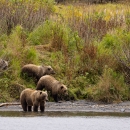
a kodiak brown bear sow with three large cubs stand on the banks of a lake
Homeland of the Alutiiq Sugpiaq peoples, Kodiak Archipelago is located in the Gulf of Alaska, 30 miles from the nearest mainland coast, across the notoriously temperamental Shelikof Strait. Kodiak National Wildlife Refuge spans almost two million acres and covers more than 2/3rds of Kodiak Island,...
A field at Buffalo Lake National Wildlife Refuge against a dark blue sky.
Buffalo Lake was created with the building of Umbarger Dam in 1938 by the U.S. Department of Agriculture. In 1958, the 7,664 acres were transferred to the Department of Interior and in 1959, Buffalo Lake National Wildlife Refuge was established. Although the lake is dry, visitors can enjoy many...
A redhead duck runs across the water on takeoff
Limited-interest national wildlife refuges are different from other national wildlife refuges. They were created in the 1930s and 1940s in response to declining waterfowl populations and the need to get people back to work during the Great Depression. During these years, hundreds of landowners...
Swans at sunset on water surrounded by mountains at Bear River Migratory Bird Refuge
Bear River Migratory Bird Refuge lies in northern Utah, where the Bear River flows into the northeast arm of the Great Salt Lake. On the ancestral homelands of the Shoshone, Paiute, Bannock, and Ute people known as the Newe or Meme (the People), the Refuge protects the marshes found at the mouth...
Media Usage Rights/License
Public Domain
Subject tags
Wildlife refuges
Wildlife management
Waterfowl
Research
Public access
Mammals
Law enforcement
History
Game management
Endangered and/or Threatened species
Employees (USFWS)
Boats
Bird banding