


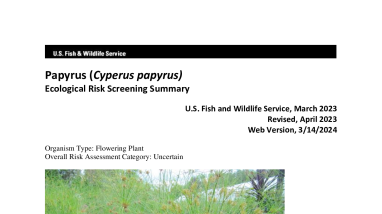
Cyperus papyrus, Papyrus, is a flowering plant that is native to most of Africa and northern Israel. C. papyrus grows in freshwater lakes, wetlands, and river estuaries. It can reach heights of 3-16 ft and is commonly used as an ornamental plant. C. papyrus has been used as an herbal medicine, food source for humans and livestock, and a source to make paper, cordage, ropes, boats, matting, mattresses, cushions, roofing, and flooring. Currently, this species is not regulated within the United States and has been introduced in California, Florida, Louisiana, Hawaii, and Puerto Rico. This species is readily available throughout the United States and can be obtained and shipped through online vendors. There was no information found that documented C. papyrus introduction impacts, but sources suggest this species has the potential to outcompete natives, impede water flow, reduce light levels to submerged plants. The History of Invasiveness for Cyperus papyrus is classified as Data Deficient due to there being no information regarding impact of introductions. The climate matching analysis for the contiguous United States indicates establishment concern for this species. Areas of high match were primarily found in southern and western areas of the contiguous United States. Certainty of Assessment for this ERSS is classified as Low due to disagreement regarding the native and introduced ranges and the lack of impact information. The Overall Risk Assessment Category for Cyperus papyrus in the contiguous United States is Uncertain.
Publication date
Type of document
Uncertain Risk
Media Usage Rights/License
Public Domain
Program

