


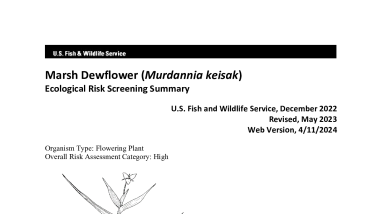
Murdannia keisak, marsh dewflower, is a flowering plant that is native to eastern Asia. It grows in damp soils around wetlands and streams and forms thick mats that can exclude other vegetation. The plant was most likely introduced into the United States as a contaminant of rice and was first documented in the 1930s in a rice paddy in South Carolina. M. keisak has been shown to outcompete native vegetation and has spread across the eastern portion of the country, as well as in Washington and Oregon. Three U.S. States regulate M. keisak as a prohibited, invasive, or quarantine species. The History of Invasiveness for M. keisak is classified as High. The climate matching analysis for the contiguous United States indicates establishment concern for this species. The highest climate matches were found where this species is currently established in the Southeast, Mid-Atlantic, and Pacific Northwest regions. The Certainty of Assessment for this ERSS is classified as Medium due to few scientific studies with data to support claims of the negative impacts of introduction of the species. The Overall Risk Assessment Category for Murdannia keisak in the contiguous United States is High.
Species that are considered high risk have a well-documented history of invasiveness in at least one location globally, and a high or medium climate match to the contiguous United States.
Publication date
Type of document
High Risk
Media Usage Rights/License
Public Domain
Program


Species