


Species that are considered high risk have a well-documented history of invasiveness in at least one location globally and are of establishment concern for the contiguous United States based on a climate matching analysis.
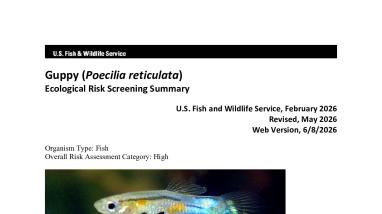
Poecilia reticulata is a freshwater to brackish water fish that is native to coastal drainages of northeastern South America. This omnivorous species can be found in a wide variety of habitats from mountain springs to turbid lowland ponds, as well as artificial environments such as thermally influenced waterways. In addition to its high adaptability, P. reticulata is a livebearer with rapid sexual maturation and reproductive cycles. While it was initially stocked as a method of mosquito control around the world, P. reticulata continued to gain popularity as an ornamental fish within the aquarium trade and as a model species for genetics research. This global popularity has led to further introductions and established populations outside of its native range. Multiple studies have documented declines in a variety of native species following P. reticulata introductions. P. reticulata is regulated in at least two U.S. States. The History of Invasiveness for Poecilia reticulata is classified as High due to evidence of established populations outside of its native range and reliable documentation of negative impacts from introductions. The climate matching analysis for the contiguous United States indicates establishment concern for this species, with high climate matches found in several areas of the southern and western contiguous United States. The Certainty of Assessment for this ERSS is classified as High due to the presence of reasonably complete information on species distribution and impacts. The Overall Risk Assessment Category for Poecilia reticulata in the contiguous United States is High.
Publication date
Type of document
High Risk
Media Usage Rights/License
Public Domain
Program


Species