Final Rule to publish the week of October 5, 2009
The U.S. Fish and Wildlife Service today announced that a final Rule will publish next week to protect slickspot peppergrass (Lepidium papilliferum), a native plant found only in southwest Idaho, as a threatened species protected under the Endangered Species Act (ESA).
The Service also determined that designation of critical habitat for the plant is prudent but not determinable at this time. As soon as the Rule publishes, federal protections provided by the ESA will become effective in 60 days.
“We have carefully assessed the best scientific information available, as well as public comments, regarding the past, present and future threats to slickspot peppergrass,” said Jeff Foss, Idaho State Supervisor for the Service. “Evidence indicates that the sagebrush sagebrush
The western United States’ sagebrush country encompasses over 175 million acres of public and private lands. The sagebrush landscape provides many benefits to our rural economies and communities, and it serves as crucial habitat for a diversity of wildlife, including the iconic greater sage-grouse and over 350 other species.
Learn more about sagebrush -steppe habitat of this species continues to degrade in quality. In particular, the most significant threats are the effects of more frequent wildfires and invasive nonnative plants, including cheatgrass. These threats will continue and likely will increase into the foreseeable future. We commend the efforts of the Bureau of Land Management, State of Idaho, Idaho Army National Guard, U.S. Air Force, and ranchers to conserve slickspot peppergrass, and their continued involvement will be key to recovering this species.”
Approximately 98 percent of the slickspot peppergrass population occurs on federal land managed by the Bureau of Land Management (BLM) and the Department of Defense. Less than one percent of the population occurs on state land and approximately 1.6 percent is found on private lands. Military lands containing slickspot peppergrass include the Juniper Butte Training Range, managed by the Mountain Home U.S. Air Force Base, and the Orchard Training Area, managed by the Idaho Army National Guard and BLM.
The ESA defines a threatened species as “any species which is likely to become an endangered species within the foreseeable future throughout all or a significant portion of its range.” The Service determined that threats to the species rangewide do not immediately threaten it with extinction but, if they continue as anticipated and are not addressed, they are likely to result in the species becoming endangered in the foreseeable future.
When a species is added to the federal list of threatened and endangered species, it is protected from adverse effects of federal activities through the ESA Section 7 Section 7
Section 7 Consultation
The Endangered Species Act (ESA) directs all Federal agencies to work to conserve endangered and threatened species and to use their authorities to further the purposes of the Act. Section 7 of the Act, called "Interagency Cooperation," is the mechanism by which Federal agencies ensure the actions they take, including those they fund or authorize, do not jeopardize the existence of any listed species.
Learn more about Section 7 consultation process. Restrictions are placed on taking, selling or transporting the species. The Service develops a recovery plan for the species and can provide financial assistance to states to help with the species’ conservation and recovery. Federal agencies, including the Service, must ensure that activities they authorize, fund or implement are not likely to jeopardize the continued existence of a listed species or adversely modify its designated critical habitat. Only federal agencies are required to take steps to conserve listed species. Other entities and private landowners are encouraged to support and carry out recovery goals for listed species but are not required to do so.
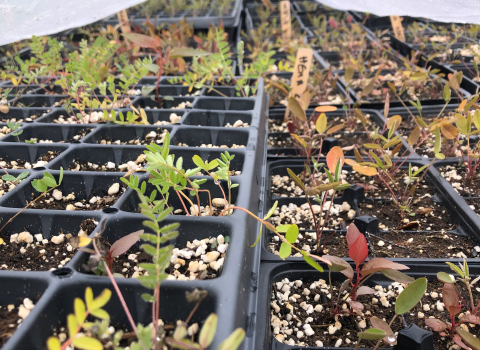
Slickspot peppergrass is unique to southwest Idaho, and it is found only in parts of the Snake River Plain, the Boise Foothills, and on the Owyhee Plateau. The herbaceous plant is a member of the mustard family, and it has numerous tiny white flowers that resemble the garden flower sweet alyssum. The plant occurs primarily in unique soil conditions that are dispersed within a semiarid sagebrush-steppe habitat.
The final Rule listing the plant as threatened will be available on the Internet at http://www.regulations.gov and http://www.fws.gov/idaho. The public will be notified when the Rule publishes. Comments and materials received, as well as supporting documentation used in the preparation of this rule, will be available for public inspection by appointment during normal business hours at the U.S. Fish and Wildlife Service’s Idaho Fish and Wildlife Office, 1387 S. Vinnell Way, Boise, Idaho 83709; by telephone at 208-378-5243; by facsimile at 208-378-5262; or by e-mail at fw1srbocomment@fws.gov.
For further information, please contact Jeff Foss, State Supervisor, U. S. Fish and Wildlife Service, Idaho Fish and Wildlife Office, 208-378-5243.