


Management and Conservation
Refuges deploy a host of scientifically sound management tools to address biological challenges. These tools span active water management to wilderness character monitoring, all aimed at ensuring a balanced conservation approach to benefit both wildlife and people. At this field station our conservation tool box includes:
- Water management for waterfowl, shorebirds and fisheries.
- Cooperative farming
- Prescribed fire
- Mechanical/chemical control of noxious plants
- Deer management with public hunting
- Public education and environmental interpretation (tours, exhibits, etc.)
- Law enforcement.
- Partnerships

Our Services
Special Use Permits
Some commercial, recreational and research activities are allowed on national wildlife refuges only with a special use permit issued by the local office, and are subject to specific conditions and fees. This permit requirement is meant to ensure that all activities at the federal site are compatible with the refuge’s Congressionally mandated wildlife conservation goals. Permits enable the public and scientific communities to engage in legitimate wildlife-related activities that would be otherwise prohibited by law. Service permit programs ensure that such activities are carried out in a manner that safeguards wildlife.
Special Use Permits
The Service has developed three different Special Use Permit (SUP) forms which may enable the public to engage in activities considered a) commercial b) research and c) other general uses.
1. National Wildlife Refuge System Commercial Activities Special Use Application and Permit (FWS Form 3-1383-C) for:
- Commercial activities such as guiding hunters, anglers or other outdoor users;
- Commercial filming (audio, video, and photographic products of a monetary value);
- Agriculture (haying, grazing, crop planting, logging, beekeeping, and other agricultural products).
2. National Wildlife Refuge System Research and Monitoring Special Use Application and Permit (FWS Form 3-1383-R) for:
- Research and monitoring activities by students, universities, or other non-FWS organizations.
3. National Wildlife Refuge System General Special Use Application and Permit (FWS Form 3-1383-G) for:
- Woodcutting;
- Nocturnal possum/raccoon hunting and frog-gigging;
- Hunting Dog retrieval
- Miscellaneous events (fishing tournaments, one-time events, other special events);
- Other (any activity not mentioned above and not usually available to the general public).
The above-referenced activities are not necessarily conducted on every refuge. Contact the Refuge Manager to inquire whether we consider the proposed use appropriate or compatible on Mattamuskeet National Wildlife Refuge.
See below for permit files. Prospective permit holders may fill out the corresponding application and return it to the refuge for processing. Please allow a minimum of six weeks for permit processing.
By email: mattamuskeet@fws.gov
By mail:
Mattamuskeet NWR
85 Mattamuskeet Road
Swan Quarter, NC 27885
The permit is not valid until approved and signed by a refuge official.
Our Projects and Research
Project goals at Mattamuskeet National Wildlife Refuge are routinely evaluated. Continuing management of the surrounding lands and water quality of Lake Mattamuskeet to support neighboring lands and the world's migratory birds are achieved in partnership with private land owners and government agency support. The refuge will continue to provide quality recreation opportunities for hunting and fishing, and will increase public use in wildlife observation and environmental education and interpretation.
Lake Mattamuskeet Watershed Restoration Plan
Declining water quality and elevated water levels threaten this natural wonder. In 2017, Hyde County, N.C. Wildlife Resources Commission, and the U.S. Fish and Wildlife Service formed a partnership and contracted the Coastal Federation to develop a watershed restoration plan.
On August 7, 2019 the Lake Mattamuskeet Watershed Restoration Plan was approved by the N.C. Department of Environmental Quality. In 2020, three grants were awarded from state and national funders to advance the implementation.
Goals:
- Protect the way of life in Hyde County;
- Actively manage the lake water level; and
- Restore water quality and clarity.
The North Carolina Coastal Federation website hosts the approved watershed restoration plan and materials from past public meetings. Interested community members and stakeholders can also sign-up for future email updates and leave comments via the project webpage. Contact Michael Flynn with any questions at michaelf@nccoast.org or 252-473-1607.
Annual Waterfowl Surveys
Mattamuskeet NWR's position along the Atlantic Flyway makes it a prime location for wintering waterfowl. Hundreds of migratory shorebirds find resting and feeding spots along the edge of the lake and throughout the marsh impoundments. Refuge staff conduct annual aerial and bi-weekly ground surveys to assess the wintering waterfowl population.
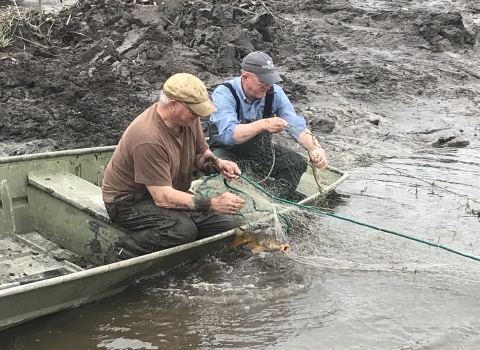
Mattamuskeet National Wildlife Refuge and the North Carolina Wildlife Resources Commission (NCWRC), working together as the Mattamuskeet Technical Working Group (abbreviated TWG), have been awarded $1 million dollars by the U.S. Fish and Wildlife Service’s Large Invasive Species grant program to remove invasive common carp (Cyprinus carpio) from Lake Mattamuskeet. The removal of common...
Law Enforcement
For any potential refuge violations or illegal activity, please contact the local refuge headquarters at 252-926-4021.