States
Georgia, North CarolinaEcosystem
River/streamIn 1992, Roanoke College’s Dr. Robert Jenkins examined two preserved specimens of a fish taken from the Little Tennessee River, one in 1981, the other in 1982. Aspects of their physical features led him to believe these weren’t just curious variations of known species, or even hybrids between two species, but something new.Close examination of physical characteristics, genetics, and behavior determined that the sicklefin redhorse was a new species. Known to river users, including the Cherokee, for centuries, and even collected by scientists, Dr. Jenkin’s work discerning it from other redhorses set in motion efforts to learn about it…and conserve it.

What is the sicklefin redhorse?
The sicklefin redhorse is a large sucker fish, growing up to 25 inches long. While many species of redhorses are found across the southeastern United States, and finding multiple species in a single river is common, the sicklefin redhorse is only found portions of Cherokee, Clay, Jackson, Macon, and Swain counties, North Carolina; and Towns County, Georgia.
Appearance
Among the redhorses, it is readily identified by its sickle-shaped back, or dorsal, fin that’s olive colored, sometimes partly red. Its body is also olive, with a coppery or brassy sheen; its lower fins are primarily dusky to dark, often tinted yellow or orange and pale edged; the tail fin is mostly red.
Habitat and life history
It lives in cool to warm creeks and rivers and, during at least parts of its early life, large reservoirs. In streams, adults are typically found in areas with moderate to fast currents, though young show a preference for slow currents and large rocks providing cover. Adults feed and reproduce over gravel, cobble, boulder, and bedrock stream bottoms with no, or very little, silt. Adults live year-round in rivers and large creeks while young are largely found in lower stream reaches of creeks and rivers and appear to have even adapted to nearshore portions of certain reservoirs. It’s likely that after hatching from their eggs, young fish are carried downstream to the mouths of streams or into reservoirs where they stay until they mature. The fish are believed to mature at around five to eight-years-old and migrate from reservoirs to spawn. It’s relatively long lived, with males living up to at least 20 years and females up to at least 22 years.
During the course of a year, adults will migrate along a river - upstream to spawn, then downstream to forage, and finally to deeper water for winter, returning to the same spawning and wintering sites year after year.
Range
The sicklefin redhorse is only found in the Little Tennessee and Hiwassee River basins of southern Appalachia. It’s suspected that fish’s historical range was limited to these two river basins, with that limited range truncated by dams within the last 100 years. The range includes portions of Cherokee, Clay, Jacskon, Macon, and Swain counties, NC; and Towns County, GA.
What biologists are doing
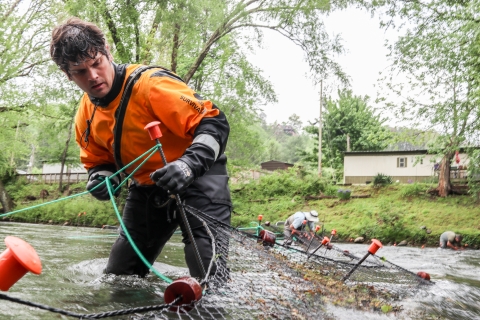
Biologists take a multi-faceted approach to conserving the sicklefin redhorse:
- Monitoring and tracking – Each spring, changing water temperature triggers sicklefin redhorse to migrate upstream for spawning, and when that happens, biologists descend on those same rivers and several intense days of field work ensue. Much of the effort is focused on simply catching sicklefin redhorses moving upstream – on smaller streams this is done by using nets to herd them into a holding pen. In bigger rivers, the biologists take to boats outfitted with electrofishing gear enabling biologists to stun the fish for easy capture and transport to shore. Captured fish are checked for a tag, and those without are given a tag. Biologists use tags to give captured sicklefin redhorses a unique identifier. In most cases, this is a passive integrated transponder, or PIT tag – the same kind of chip tag used for pets. By running a scanner over a captured fish’s tag, its unique identifier appears on the scanner’s screen and is noted. By tracking the number of tagged fish that are recaptured versus the number of untagged fish caught, biologists can estimate population size. As fish are recaptured across the river basins, biologists begin to with a picture of where the fish are going. In some years, biologists working with the sicklefin redhorse lay a strip across the bottom of the stream that recorded when a tagged fish swims over it, and this information can be periodically downloaded. Radio transmitter tags have also been used in a small number of fish, allowing biologists to actively find and follow individuals without needing to capture them. If any captive propagation is on tap for the year, this moment is used to collect eggs and sperm from the fish.
- Captive propagation, rearing, and stocking – Fish produce hundreds of offspring, most of which do not survive to adulthood. To boost the number of individuals surviving, biologists collect sicklefin redhorse eggs and sperm and mix the two (tradition calls for using a turkey feather), on the stream bank, fertilizing the eggs. These fertilized eggs are then taken into hatchery facilities, where the eggs can hatch and young individuals grow, safe from predation and the harsh conditions that may be found in a river. Young individuals are then returned to the river to continue growing into adulthood.
- Range expansion – With a range limited by dams, opportunities for major, permanent range expansion are limited, however the 2010 removal of the Dillsboro Dam on the Tuckasegee River allowed sicklefin redhorse to colonize upstream habitat. Discussions are currently underway to remove Ela Dam on the Oconaluftee River, a tributary to the Tuckasegee River. Other range expansion efforts have focused on placing sicklefin redhorse upstream of the dams serving as a barrier to movement.
Much of the effort to conserve the sicklefin redhorse is laid out in a Candidate Conservation Agreement, a voluntary agreement designed to address imperiled species conservation through proactive measures before the plant or animal needs the full protection of the Endangered Species Act. The agreement for the sicklefin redhorse formalized and expanded on conservation efforts that were already underway when it was signed. Signatories to the agreement are the North Carolina Wildlife Resources Commission, Duke Energy Carolinas, the Tennessee Valley Authority (TVA), Eastern Band of Cherokee Indians, Georgia Department of Natural Resources, and the Service.
Partners
The core members of the sicklefin redhorse conservation committee, i.e., signatories to the Candidate Conservation Agreement are:
- Eastern Band of Cherokee Indians
- Georgia Department of Natural Resources
- North Carolina Wildlife Resources Commission
- Tennessee Valley Authority
- U.S. Fish and Wildlife Service
- Duke Energy - Though a signatory to the agreement, Duke Energy has since divested themselves of hydropower facilities within the range of the sicklefin redhorse and therefore is no longer an active member of the partnership
Other organizations involved in sicklefin redhorse conservation include:
- Conservation Fisheries, Inc.
- Mainspring Conservation Trust
- Mountain True
- North Carolina State University
- U.S. Forest Service
- University of Georgia
- Western Carolina University
- Young Harris College
Timeline
1992
- Dr. Robert Jenkins examines specimens from the Little Tennessee River, recognizing them as a potentially distinct species of redhorse. Detailed physical, behavioral, and genetic studies concluded that the sicklefin redhorse is, in fact, a distinct species.
2005
- Driven by concerns over impacts from migration barriers, water quality, non-native fish, and other factors, the Service designates the fish a candidate for the federal threatened and endangered species list, meaning it warrants being on the list, but going through the listing process was superseded by higher priority species.
- Sicklefin redhorse listed as endangered under Georgia’s Endangered Wildlife Act.
- Georgia Department of Natural Resources begins monitoring sicklefin redhorse in Brasstown Creek.
- North Carolina Wildlife Resources Commission begins working with partners to assess spawning habitat, estimate population size and genetic structure, and collect gametes for captive propagation in the Little Tennessee River system.
2007
- Service begins working with Conservation Fisheries, Inc., the Eastern Band of Cherokee Indians, N.C. Wildlife Resources Commission, and Tennessee Valley Authority to propagate sicklefin redhorses and reintroduce them to parts of their historic range.
- Eastern Band of Cherokee Indians begins stocking Oconaluftee River upstream of Ela Dam, annually through 2015.
- North Carolina Wildlife Resources Commission begins stocking juvenile sicklefin redhorses in the Tuckasegee River upstream of Dillsboro Dam.
2008
- Scott Favrot, an N.C. State University graduate student, conducts a study on the reproduction and habitat ecology of adult sicklefin redhorses in the upper Hiwassee River basin.
2009
- Annual stakeholder meetings begin and continue to present day.
2010
- Duke Energy removes the Dillsboro Dam, on the Tuckasegee River, enabling the sicklefin redhorse to expand its range in the river upstream.
- The Center for Biological Diversity petitions the Service to place the sicklefin redhorse on the federal threatened and endangered species list.
2013
- Young male sicklefin redhorse collected upstream of the site of the former Dillsboro Dam.
- Georgia DNR contracts with Dr. Jonathan Davis of Young Harris College to develop a monitoring protocol based on visual observations and seining.
- Service, Eastern Band of Cherokee Indians, Tennessee Valley Authority, Duke Energy, North Carolina Wildlife Resources Commission, and Georgia Department of Natural Resources sign the Sicklefin Redhorse Candidate Conservation Agreement, formalizing conservation efforts and committing resources to the sicklefin redhorse. Ceremonial signing occurs in early 2016.
2014
- Tomas Ivasauskas, a graduate student at N.C. State University, begins examining the impacts of blueback herring, an introduced species, on sicklefin redhorse.
- Kyle Stowe, a graduate student at Western Carolina University, completes a thesis on movement patterns and habitat use by juvenile and adult sicklefins redhorses in the Tuckasegee River basin.
- UNC-Asheville undergraduate Jessica Davis begins a project tracking sicklefin redhorses with radio transmitters released into the Oconaluftee River upstream of Ela Dam.
2016
- Service concludes Endangered Species Act protection is not warranted for the sicklefin redhorse.
- Sicklefin redhorses with radio transmitters released into the Oconaluftee River upstream of Ela Dam.
2021
- Sediment slug released from Ela Dam, on the Oconaluftee River, triggering efforts to remove the dam.
2022
- Biologists surgically implant radio transmitters into a handful of sicklefin redhorses taken from the Oconaluftee River downstream of Ela Dam, which are then released into the Oconaluftee River upstream of the dam. Tracking the radio transmitters allows biologists to see where they go once they are upstream of the dam.
Sources
Endangered and Threatened Wildlife and Plants; 12-Month Findings on Petitions to List 10 Species as Endangered or Threatened Species, Vol. 81, No. 194. Thursday, October 6, 2016 Federal Register § 4500090022 (2016).
Davis, Jessica L.; Gillette, David P.; Rossell, C. Reed Jr.; and LaVoie, Michael J. (2020) "Movement of Translocated Adult Sicklefin Redhorse (Moxostoma sp.) in the Oconaluftee River, North Carolina: Implications for Species Restoration," Southeastern Fishes Council Proceedings: No. 59. Retrieved March 28, 2023, from https://trace.tennessee.edu/cgi/viewcontent.cgi?article=1294&context=sf…
Favrot, S. D. (2009). Sicklefin Redhorse Reproductive and Habitat Ecology in the Upper Hiwassee River Basin of the Southern Appalachian Mountains (M.S. thesis). North Carolina State University, Raleigh, North Carolina. Retrieved March 28, 2023, from https://repository.lib.ncsu.edu/handle/1840.16/134
Ivasauskas, T. J. (2017). Early Life History of Suckers (Catostomidae) in a Southern Appalachian River System (doctoral dissertation). North Carolina State University. Retrieved March 28, 2023, from https://repository.lib.ncsu.edu/bitstream/handle/1840.20/33704/etd.pdf?…
Stowe, K. A. (2014). Movement Patterns and Habitat Use by Juvenile and Adult Sicklefin Redhorse (Moxostoma Sp.) in the Tuckasgee River Basin (M.S. thesis). Western Carolina University. Retrieved March 28, 2023, from https://libres.uncg.edu/ir/wcu/f/Stowe2014.pdf
U.S. Fish and Wildlife Service. (2016). Species Status Assessment Report for the Sicklefin Redhorse. Asheville, NC: U.S. Fish and Wildlife Service. 41 pp. Retrieved March 27, 2023, from https://ecos.fws.gov/ServCat/DownloadFile/169928
U.S. Fish and Wildlife Service. 2015. Candidate Conservation Agreement for the Sicklefin Redhorse (Moxostoma sp.). Asheville, NC. 40 pp.