Location
States
ArizonaEcosystem
River/streamIntroduction
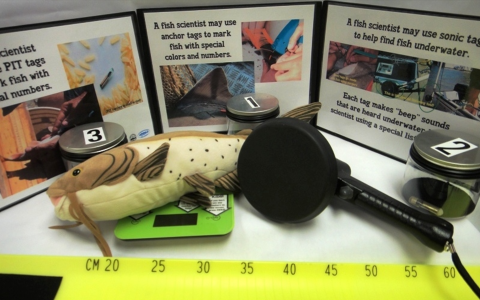
Between January 2009 and May 2011, Sharing Tails provided free, state-wide public outreach and education to kindergarten through second grade students about Arizona’s native fishes. Seventy percent of native Arizona fishes are federally listed as endangered, threatened, or identified as Wildlife of Special Concern. Sharing Tails was created to bring awareness of native fishes to Arizona residents, including knowledge about the threats to their survival.
After funding for Sharing Tails ended, Marsh Education formed in 2013 as a not-for-profit 501(c)3 branch of Marsh & Associates LLC, which enabled the Sharing Tails program to resume classroom visits during the 2015-2016 school year. Sharing Tails is now a fee-based program, and through continued fundraising, donations, and a grant from the Sea Life Trust, has reached more than 42,000 students since 2008. Two more programs, Camp Sharing Tails and Sharing Tiny Tails, were also created to involve pre-kindergarten students and other students after school and during breaks.
Key Issues Addressed
Education and outreach are an essential contribution to teaching the public about the importance of native fish species in Arizona. Current information provided by local, private organizations, and state and federal agencies indicate that awareness about native fish awareness in Arizona is lacking, is viewed as uninteresting, and is intermittent at best. Most public outreach programs about Arizona’s native fishes did not actively reach out to teachers, required fees that prohibited use, were only available online, or were restricted to certain areas within the state. Public outreach is important because out of the 36 fish species native to Arizona, one species is already extinct, 34 are identified as Species of Greatest Conservation Need in Arizona, and 20 are federally-listed as endangered or threatened. These include a diverse range of species such as Humpback Chub (Gila cypha), Razorback Sucker (Xyrauchen texanus), and Apache Trout (Oncorhynchus apache) that reside in different waters, from the Colorado River to intermittent streams. Many factors have resulted in their decline, including non-native species introductions, irrigation diversion, dam construction, and overuse of water resources. These factors have led to the fragmentation and reduction of habitat available to native species. Government agencies, conservation organizations, and community members have been working to restore native fish populations. Public outreach and education to school-age children is critical for native fish conservation and recovery because they potentially could become future stewards and advocates of Arizona’s unique native species.
Project Goals
- Develop a state-wide outreach program to educate Arizona’s children about native Arizona fishes
- Create excitement in children who potentially could become future stewards and advocates of Arizona’s unique native species
Project Highlights
Accessible Education: The program’s mobility provided opportunities to schools around the state, whose remote locations and limited budget prevent them from traveling to off-campus programming.
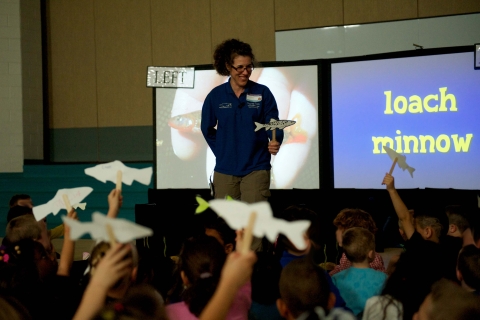
- Engaging Activities: The program attempted to excite students about native fish through immersive activities such as blowing bubbles, pretending to go underwater, presenting colorful photos, showing videos and cartoons, and using life-sized fish models and fish replicas. Using grade-level appropriate multimedia presentations and hands-on activities 33,285 students and 1,467 teachers participated in the program.
- Teacher Involvement:The program worked closely with teachers in every aspect of implementation and adjusted materials per teacher suggestions whenever possible. The program used teacher-assisted student assessments both to measure outcomes of the training activities and to survey participating teachers.
- Additional TailsPrograms: This program developed two additional outreach programs. 1) Camp Sharing Tails provides programs for students from kindergarten up to 8th grade, with programs adapted for after-school care or spring/summer/winter camps. 2) Sharing Tiny Tails is a program for pre-kindergarten.
Lessons Learned
When developing a new program delays in the grant proposal process could delay implementing a new curriculum. While the multi-year target number of kindergartners was met, targets for the first year of the program were not, since program development was unable to start until funding was received.
As a new program in Arizona with no prior history or results, there were no references or endorsements from any outside agencies other than the funding agency. As a result, school districts, principals, and teachers may have been initially cautious or reluctant to sign-up and participate in the program. Due to improved communication and outreach methods and increased knowledge of the program, Sharing Tails showed an increasing number of participants each year, especially through more direct communication about the program from teachers to parents. Often kindergarten parents were classroom volunteers and attended onsite presentations which also resulted in engaging with teachers and learning more about the program.
There are at least five elements of a successful outreach program to engage non-scientific audiences:
- Have participants experience the “wonder of science” as well as learn scientific information.
- Teachers should be directly involved with preparation for education programs. Teachers can prepare students for the program by providing pre-visit lessons.
- A program should provide guidance to scientists regarding how learning experiences can be created by scientists for participants.
- Participant training offered by the Program Coordinators for local teachers is critical for successful outreach programs.
- Having program metrics for assessing success (such as number of students reached), is necessary to document success, but is generally lacking in many environmental education programs.
Development of the Sharing Tails program was mindful of these elements while it also maintained resolve to fulfill its program goal and objective.
Next Steps
- Adapt current program material to updated Arizona Science Standards
- Generate funding alternatives that could make the program free to Arizona public elementary schools
Funding Partner
Resources
- Marsh Education Website
- Pace, C., A., and Marsh, P., C. (2013). “Sharing Tails®: A state-wide public outreach program teaching children about native Arizona fish.” Applied Environmental Education & Communication 12(4): 254-260.
- Brewer, C. (2002). “Outreach and partnership programs for conservation education where endangered species conservation and research occur.” Conservation Biology 16(1): 4–6.
- Crohn, K., Birnbaum, M. (2010). “Environmental education evaluation: Time to reflect, time for change.” Evaluation and Program Planning 33(2): 155–158.
Contact
- Carol Pacey, Program Manager, Marsh Education, cpacey@nativefishlab.net
Case Study Lead Author
- Deanna Morrell, Program Analyst, Bureau of Reclamation, dmorrell@usbr.gov
Suggested Citation
Morrell, D.P. (2020). “Expanding Public Outreach to Connect Youth to Native Arizona Fishes.” CART. Retrieved from https://www.fws.gov/project/connecting-youth-native-fishes.