


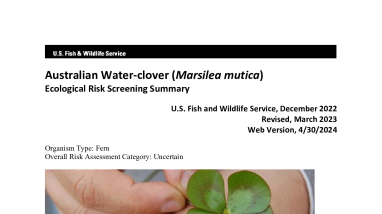
Marsilea mutica, Australian Water-clover, is a perennial aquatic fern that is native to Australia and New Caledonia. Appearance is like that of a four-leaf clover, with the overall diameter being up to 8 cm. It lives in lakes, ponds, and along waterways, rooting in sandy to heavy clay soils in water depths of 1 m or less. Marsilea mutica more often spreads vegetatively via rhizomes than sexually via sporocarps. The first wild observation of Marsilea mutica in the United States was in Virginia in 2001. Since then, observations have been reported in a total of fifteen states but established wild populations have only been recorded for Washington, Maryland, North Carolina, Georgia, Alabama, and Texas. Exact estimates on trade volume could not be located, but several websites in the United States sell this species commercially as a decorative plant for use in ponds and water features. Oklahoma, Louisiana, and Washington regulate possession and trade of Marsilea mutica. No information could be found on impacts associated with established populations of Marsilea mutica in the wild. The History of Invasiveness for Marsilea mutica is classified as Data Deficient due to a lack of documentation of impacts or lack of impacts from species introductions and establishment. The climate matching analysis for the contiguous United States indicates establishment concern for this species. Most of the contiguous United States was predicted to be a high climate match for this species, with only portions of the northern Great Plains predicted to be a low match. The Certainty of Assessment for this ERSS is classified as Low due to the lack of information regarding the impacts of introduction and establishment. The Overall Risk Assessment Category for Marsilea mutica in the contiguous United States is Uncertain.
Species that are considered uncertain risk need a more in-depth assessment beyond the Risk Summary to better define the species’ risk to U.S. environments.
Publication date
Type of document
Uncertain Risk
Media Usage Rights/License
Public Domain
Program


Species