Featured Species
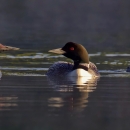
A total of 245 bird species have been observed on the refuge, and 137 species are known to breed there. There are many species of songbirds, including 24 varieties of warblers. The abundance of fish in the lakes and rivers provide food for the local populations of Osprey and Bald Eagles. Mink, otter, muskrat, and beaver can be seen in the lakes and rivers while black bear, bobcats, fishers, marten, white-tailed deer and moose inhabit the uplands. The extensive wetlands and marshes provide ideal habitat for waterfowl, such as common mergansers, American black ducks and common goldeneye and common loons.
Migratory non-game birds like the northern harrier, American Bittern and Great Blue Heron depend on habitat around Umbagog Lake. The areas forested wetlands support good numbers of black ducks, ring necked ducks, and goldeneye. Wood Ducks, Mallards, Hooded and Common Mergansers also nest in the area. The lake provides habitat for migrating scaup, three varieties of scoters and Canada Geese.
A transition zone home to many species
Umbagog National Wildlife Refuge is located in the mixed spruce-fir/northern hardwood forest. This marks the transition zone between the deciduous (hardwood) forests, and the northern, or boreal coniferous forests. Most of the boreal forest range lies in Canada, but the southern extent reaches into northern New Hampshire. Some of the birds on the Refuge are northern birds at the southern extent of their range, and therefore are rare in New Hampshire.Some of the boreal bird species found in the Umbagog area include: Canada Jay, Boreal Chickadee, Spruce Grouse, Olive-sided Flycatcher, Black-Backed Woodpecker and Palm Warbler.
Good Places to View Northern Forest Birds
Northern bird species can be found in suitable habitat throughout the refuge. Route 16, between Errol and Refuge Headquarters, passes boreal wetlands and spruce/fir forest in which to look for these birds. There is also suitable habitat along Greenough Pond Road, especially near Long Pond and Bear Brook Pond. Mollidgewock Road, Mountain Pond Road, and the Magalloway River Trail are other areas where boreal birds may be encountered, as well as sections of Umbagog’s lake shore and rivers, especially near the marshes and meadows.
Bald Eagle History at Umbagog
Throughout the 1980's Massachusetts and New York released dozens of young, transplanted eagles into the wild (Martin, 2001). One male, released in New York in 1984, made his way to Umbagog Lake and in 1989 began nesting with a female eagle at Leonard Pond, at the north end of Umbagog Lake. This was the first Bald Eagle nest discovered in New Hampshire in 40 years, and it was built in the very same tree that held the last successful nest in 1949.
Initially, the eagles behaved as though they had young and biologists assumed there were one or more chicks in the nest. Then suddenly the behavior of the eagles changed, and it became clear that the chick(s) had not survived. Working quickly, biologists found a captive-raised chick to put in the nest. Placing a foster chick into a nest that already has a chick is not that uncommon. However, placing a foster chick into an empty nest was unusual and we anxiously awaited the results. The experiment worked and the eagles accepted and successfully raised the foster chick. During the next breeding season the adults fledged two young of their own.
The Leonard Pond territory has remained continuously active since 1989. Between1989 and 2001, the nest produced 16 young (including two foster chicks). The original banded female paired with several different males during that time. The original male of the pair died from suspected lead poisoning in 1994, and the female immediately paired with a second male. That second male disappeared after 1999 and the female paired with a new male. 2001 marks the last year that the original banded female (then 16 years old) was confirmed to have nested at Leonard Pond. In 2002, an unidentified pair of eagles occupied the Leonard Pond territory, but failed to lay any eggs. During 2003 through 2005, a new, unbanded pair occupied the territory but failed to successfully hatch any chicks. However, in 2006 the nest was successful and three healthy chicks were fledged.
Since the first eagle pair nested at Leonard Pond in 1989, two other nesting eagle territories have been established in the vicinity of Umbagog Lake. One of these, located east of the lake, has successfully fledged chicks each year since it was first observed in 2000. In 2005 a third eagle territory was established in Sweat Meadow, and in 2007 a nest was discovered in Rapid River.
Loons of the Umbagog Area
By the early 1900s, Common Loon populations in the northeastern United States had decreased dramatically. This was largely due to unregulated shooting and the collecting of eggs and birds by sportsmen, scientists, and hobbyist naturalists, along with accelerating rates of shoreline development. Since 1918 loons have been legally protected, though they still face a number of threats including habitat loss, contaminates, lead poisoning or entanglement from fishing activity, and boat strikes.
Umbagog Lake became a focal area for loon monitoring and research in 1976 and in-depth studies of Umbagog’s loon population have been on-going ever since. The refuge has one of the higher populations of nesting loons in New Hampshire. In over 50 years of monitoring, Umbagog’s loon numbers have suffered two crashes due to unknown reasons after climbing to a high of 32 pairs in 2002.
Umbagog Lake and the Magalloway and Androscoggin Rivers are broken into 34 potential loon territories, and three ponds on the refuge are included in the survey and monitoring effort. Many of the lake’s coves hold their own territorial pair, with islands and marshy areas favored as nest sites. Nesting season begins in May and may continue well into July, with most chicks hatching in late June and early July.