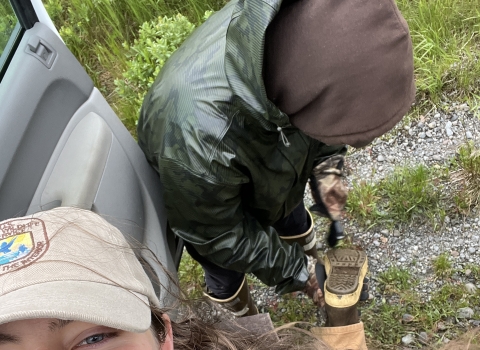
National wildlife refuges, which offer a range of wildlife-dependent recreation, scored a solid "A" for visitor satisfaction, according to a recent survey.
Ninety-five percent of visitors to wildlife refuges said they "agreed" or "strongly agreed" that they were satisfied with their experience, according to a soon-to-be-published U.S. Fish and Wildlife Service survey administered at 47 wildlife refuges.
The overall satisfaction rating was a 4.48 on a five point scale. Only two percent of respondents reported they were dissatisfied with their overall experience.
"This is heaven on Earth," wrote one respondent. "Thumbs up!"
Visitors were most satisfied with the service they received from employees and volunteers. They ranked their satisfaction level at a 4.7 rating out of a possible five. Respondents specifically noted that employees and volunteers were courteous and answered questions about the refuge, and its fish, wildlife, plants, habitats and recreational opportunities.
"We are extraordinarily proud of these results," said U.S. Fish and Wildlife Service Director Steve Williams. "The Refuge System is providing quality recreation and family education programs that will benefit the health of our wildlife resources for generations to come."
The National Wildlife Refuge System, committed to conserving and enhancing fish, wildlife, plants and their habitats, offers a range of wildlife-dependent recreation: wildlife observation and photography, some of it from the 2,500 miles of land and water trails; fishing on more than 270 wildlife refuges; hunting on more than 300 refuges; and natural resource interpretation and education.
Survey results are based on responses from 2,456 visitors at 47 wildlife refuges in the fall 2004, during the peak migration of waterfowl and songbirds and the surveyed refuges represent a cross-section of National Wildlife Refuges, based on number of visitors and staff, physical size, and geographic location, a time when visitors flock to wildlife refuges as well.
Those who reported dissatisfaction pointed to the condition and quality of roads as well as the number of parking spaces ? issues that have been focal points for National Wildlife Refuge System improvements.
Of the visitors who paid a fee, whether for entry to the refuge or for a specific service, 83 percent agreed that the fee was appropriate; nine percent thought the fee was too low. Additionally, eight percent of respondents voiced concerns about the level of funding for refuges.
Established on March 14, 1903, by President Theodore Roosevelt, the National Wildlife Refuge System encompasses 545 wildlife refuges across nearly100 million acres. It provides habitat for more than 700 species of birds, 220 kinds of mammals and more than 200 types of fish. Each year, millions of migrating birds rest and feed within this network of lands as they fly south for the winter and return north for the summer.
National Wildlife Refuges are premier vacation and outdoor destinations. Each year, more than 40 million people visit National Wildlife Refuges. More than 6 million people visit National Wildlife Refuges to hunt and fish, and millions more to photograph or simply observe wildlife.
"Welcoming and orienting visitors to wildlife refuges is a priority for us and we are working very hard to bring people closer to the outdoors," said Assistant Director for Refuges William Hartwig.
Wildlife refuges are also a boon to local economies. They created nearly 19,000 jobs and more than $318 million in employment income, according to the Banking on Nature 2002 report. The total for sales and tourism related revenue plus employment income - $1.12 billion - is nearly four times the $320 million that the National Wildlife Refuge System received in fiscal year 2002 for its operation and maintenance.
The U.S. Fish and Wildlife Service is the principal Federal agency responsible for conserving, protecting and enhancing fish, wildlife and plants and their habitats for the continuing benefit of the American people. The Service manages the 100-million- acre National Wildlife Refuge System, which encompasses 545 national wildlife refuges, thousands of small wetlands and other special management areas. It also operates 69 national fish hatcheries, 64 fishery resources offices, and 81 ecological services field stations. The agency enforces Federal wildlife laws, administers the Endangered Species Act, manages migratory bird populations, restores nationally significant fisheries, conserves and restores wildlife habitat such as wetlands, and helps foreign and Native American Tribal governments with their conservation efforts. It also oversees the Federal Assistance program, which distributes hundreds of millions of dollars in excise taxes on fishing and hunting equipment to State fish and wildlife agencies.