
Species that are considered uncertain risk need a more in-depth assessment beyond the Risk Summary to better define the species’ risk to U.S. environments.
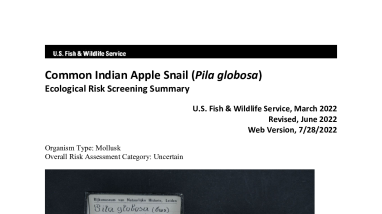
Pila globosa, the common Indian apple snail, is a freshwater and terrestrial snail that is native to India, Bangladesh, Myanmar and Sri Lanka. It is widely used as a food source for humans and livestock and as a control for weedy aquatic plants in its native range. Pila globosa has been reported as introduced outside its native range within India, but establishment is unknown. No information on impacts from the introduction was found. There was no indication this species is in trade beyond its native range. The history of invasiveness for this species is classified as No Known Nonnative Population. The overall climate match for the contiguous United States for this species was Medium. Peninsular Florida had a medium-high climate match. Areas of medium match were also found along the Gulf and southern Atlantic coasts. The remainder of the contiguous United States had a low match. The certainty of assessment is Low due to a general lack of information on introductions. The overall risk assessment category for Pila globosa is Uncertain.
Publication date
Type of document
Uncertain Risk
Program


