Written By

The Pacific Islands Coastal Program works with partner organizations and community volunteers to document, monitor and protect the number of “honu” (Hawaiian green turtle) nests on the island of Oahu. Honu are a beloved and iconic marine species, revered in native Hawaiian culture.
Honu populations were decimated after an unsustainable commercial harvest of honu adults and eggs for human consumption. By the mid-1900s, nesting was no longer observed in the main Hawaiian Islands and honu were listed as endangered under the Endangered Species Act in 1978. At that time, no significant nesting was observed outside of Lalo (French Frigate Shoals), a small, low-lying atoll in Northwester Hawaiian Islands. The honu population in Hawaii has rebounded in recent decades and conservation efforts by numerous partners led the U.S. Fish and Wildlife Service and the National Oceanic and Atmospheric Administration to downlist honu in Hawai’i to threatened in 2015.
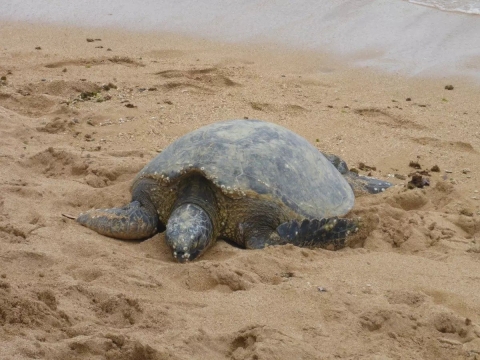
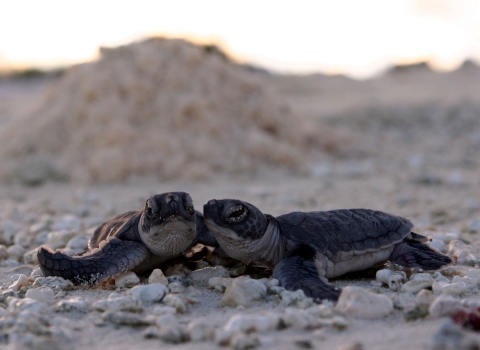
Honu females imprint on the magnetic signature of the beaches where they are born. Every two to five years, this “magnetic map” guides adult females back to the same stretch of coastline to lay their own eggs; a process called natal homing. They excavate a hole in the sand and lay 75 to 200 eggs over the course of several months. Depending on the temperatures, the eggs hatch after 45 to 75 days and the hatchlings emerge from the nest usually at night where they orient to the brightest horizon and dash to the ocean.
In the Hawaiian Islands, artificial night-time lighting from development is the biggest threat to hatching honu. Bright white lights disorient hatchlings, leading them inland instead of towards the ocean. Other significant threats include the loss and degradation of sandy beaches critical for nesting from coastal development and shoreline hardening that destroys beaches, and rising sea levels which flood nests and erode beaches. Threats in the water include entanglement in discarded fishing line and nets, polluted runoff, collisions with boats, and marine plastic that honu mistake for food.
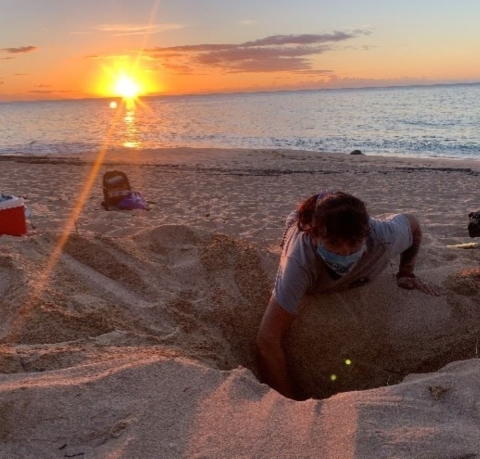
Since 2016, the Coastal Program has teamed up with the local conservation organization, Mālama i nā Honu, to train and organize community volunteers to survey all the beaches on Oahu for honu nests.Once found, volunteers and staff monitor nests, address potential threats, and excavate nests after hatchlings emerge to collect data on the number of eggs laid, hatchling success, emergence success, and other nest metrics. Starting in 2019, a GIS-based data collection app was used by all volunteers and staff to improve the accuracy and efficiency of data collection and improve protection of nests. This year, the partnership has over 100 volunteers walking all beaches on Oahu.
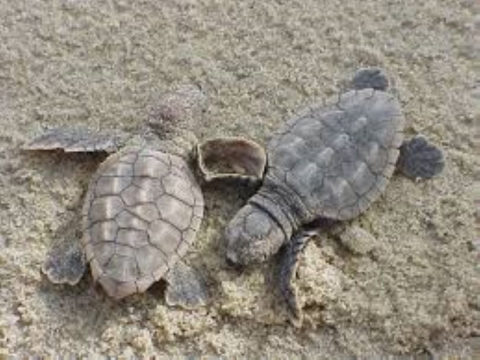
Permitted biologists from the Coastal Program and Mālama i nā Honu lead the nest excavations to collect data. Last spring, initial signs of hatchling emergence were observed at a nest at popular Sandy Beach. Seven hatchlings emerged in one night, but no other hatchlings emerged the following 2 nights. It was clear something was keeping the honu hatchlings from emerging normally. The biologists received permission to excavate the nest early to investigate. Over 100 community members observed the excavation of more than 50 live hatchlings that were entangled in discarded fishing line that was preventing them from emerging. The staff allowed community members to release hatchlings on the beach, and everyone cheered as the hatchlings walked into the ocean and made it through the surf. Several of the observers commented that they were deeply moved by the experience.
In 2024, 83 nests were found in Oahu, a record number. That is compared to only 9 nests found in 2019 and between zero and two nests found each year from 2016 - 2018. This community-based partnership is showing enormous success at increasing honu nest success and hatchling survival and building community understanding and support for sea turtle conservation on Oahu.