Written By

Aiken County, South Carolina between Augusta and Columbia is a hotbed of ecological diversity.The coastal plain bottomland wetlands, dry sandhills forests, and Piedmont streams converge to create an assemblage of habitats that support rare plant and animal species.It is this ecological diversity that led the Coastal Program and other organizations, to partner with Aiken Land Conservancy to protect corridors for rare species and ecosystems through conservation easements, preserving the rural character of Aiken County.

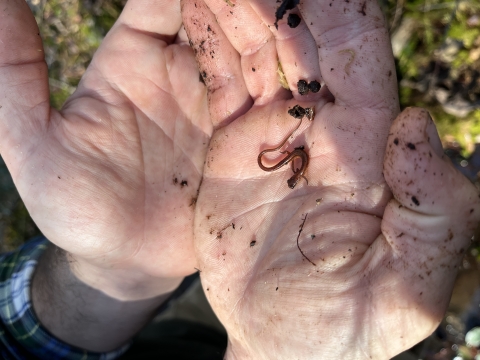
Towards the east side of the county are the headwaters of the Edisto River, North America’s longest free-flowing blackwater river. The forested wetlands along the river and its tributaries are crucial to preserving the water quality along the 250-mile river. These wetlands are prime habitat for the Chamberlain’s dwarf salamander, a tiny, secretive amphibian found in sphagnum moss. Researchers from Kennesaw State University and the South Carolina Department of Natural Resources (SCDNR) have found Chamberlain’s dwarf salamanders on several protected and privately-owned properties.
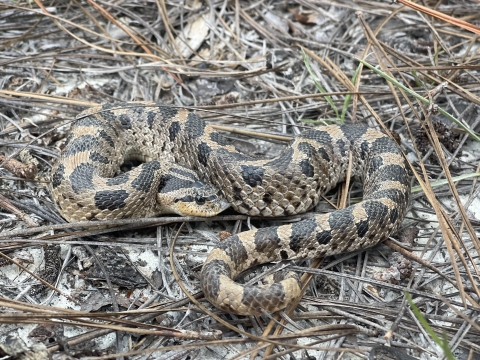
In the sandhills, dry soils and longleaf pine forests provide habitats for rare plants and animals, including reptiles such as the Southern hognose snake and gopher tortoise. Once covering millions of acres, the longleaf pine ecosystem has been reduced to a small fraction of its original range due to development and fire suppression.
The Coastal Program is partnering with the Aiken Land Conservancy to fill in gaps between protected lands to create habitat corridors. Currently, the partnership is working to connect Aiken State Park, which sits along the South Fork of the Edisto River and provides much-valued river access, and the Aiken Gopher Tortoise Heritage Preserve. The Coastal Program is also assisting the Conservancy and other partners to identify properties with habitats for species like Chamberlain’s dwarf salamander and Southern hognose snake and engage landowners interested in placing conservation easements on their property.
The Coastal Program will pay for the cost of due diligence for conservation easements on those properties to alleviate the financial burden on private landowners.The goal of the partners is to establish a network of private and public lands that protect Aiken County’s unique landscape.