


The Visitor Center is currently open for visitor registration and orientation from 9:00 a.m. to 4:00 p.m., Wednesday through Sunday. The Center is closed on Mondays, Tuesdays, and all federal holidays. The auto tour and trails are open daily from sunrise to sunset.
If you arrive when the Visitor Center is closed, please proceed to the kiosk located at the front of the building. There, you may complete one of the manila envelopes, submit your fee or record your pass information, and pick up a map before entering the refuge. For added convenience, Aransas National Wildlife Refuge also offers the option to pay entrance fees or purchase an annual pass in advance through recreation.gov.
To get to the auto tour and trails, follow the road past the Visitor Center. Public restrooms are available outside the Visitor Center after hours.
Visit Us
Aransas National Wildlife Refuge is a bit "off the beaten path," but it's well worth the visit! We invite you to drive our 16-mile auto tour, fish from our pier, walk up our observation towers, and relax and enjoy a picnic overlooking San Antonio Bay. Take time to stretch your legs along several miles of walking trails. You’ll find observation platforms, diverse plants and wildlife, and stunning views of the bay and wildlife habitat.
Location and Contact Information

Find information about 2025 rifle and archery hunts here.
About Us
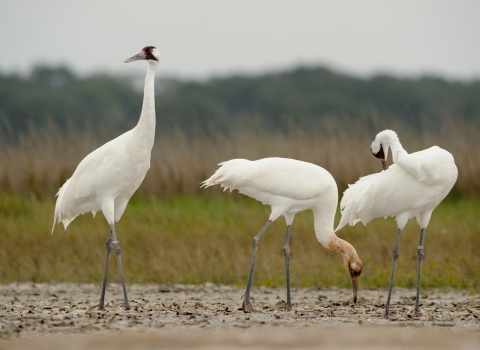
Established in 1937 for migratory waterfowl and other wildlife, Aransas National Wildlife Refuge now encompasses more than 115,000 acres of diverse habitat along the Texas Gulf Coast. Perhaps best known as the wintering home of the last wild flock of endangered Whooping Cranes, the refuge is also home to a diversity of migratory birds and other resident wildlife.
What We Do
The National Wildlife Refuge System is a series of lands and waters owned and managed by the U.S. Fish and Wildlife Service. Wildlife conservation is at the heart of the refuge system. It drives everything we do from the purpose a refuge is established, to the recreational activities offered there, to the resource management tools we use. Selecting the right tools helps us ensure the survival of local plants and animals and helps fulfill the purpose of the refuge.
Our Species
The mild winters, bay waters and abundant food supply attract more than 400 species of birds to the Aransas National Wildlife Refuge, including the whooping crane, one of North America’s rarest birds.
