
The U.S. Fish and Wildlife Service (Service) is seeking applications from qualified agricultural producers to conduct farming activities under the Cooperative Agriculture Program at Pocosin Lakes National Wildlife Refuge (NWR) in Hyde County, North Carolina. The purpose of the cooperative farming program is to provide food for wintering waterfowl and other wildlife.
To be considered, applicants must complete and submit the bid form and special use permit application available on the refuge website. Applications must be received by January 31, 2024 at 4:00 pm. Applications can be submitted to the attention of Sarah Toner via email (sarah_toner@fws.gov), mail (Pocosin Lakes National Wildlife Refuge, PO Box 329, Columbia, NC 27925), or in person at the Refuge Headquarters (205 South Ludington Dr, Columbia, NC 27925). All applicants will be notified by February 12, 2024.
For more information, please contact Visitor Services Manager Sarah Toner at 252-256-0316 or sarah_toner@fws.gov.
Background
Pocosin Lakes NWR was established in 1963 as an inviolate sanctuary for migratory birds and to protect and conserve wetlands for migratory birds and other benefits. The Refuge’s Comprehensive Conservation Plan (CCP) identifies cropland as a habitat to manage intensively for wildlife. The Service has determined that cooperative agriculture is an appropriate, compatible and necessary use of the refuge to meet this objective.Our goal is to provide energy-rich agricultural crops for waterfowl, which together with wetland management and sanctuary, contribute towards a healthy, viable waterfowl population. Unharvested agricultural crops provide the greatest energy density food for waterfowl. Efforts on the refuge are in support of Atlantic Flyway management, the North American Waterfowl Management Plan, and the refuge’s CCP.
All farm units are multi-use areas that are open to the public, including hunting and fishing, for at least part of the year.Public use, including restrictions on vehicle access, is described in the General Refuge Regulations (pocosin_tearsheet) and Hunting Regulations (hunt_regs) documents. Some farm units include waterfowl impoundments that are flooded annually. The farming areas are also used by endangered species including red wolves and northern long-eared bats. Management of these and other wildlife species may cause interruption and delays in planned farming activities to minimize impacts to these species. Cooperators must plan to work with Service staff to coordinate farming activities.
The Proposed Cooperative Agriculture Agreement
The selected applicant will operate under a Cooperative Agriculture Agreement (CAA) as a “cooperator” with the Service. The cooperator will have the use of two tracts of land totaling approximately 494 acres of cropland for the 2024 and 2025 growing seasons.Refuge staff are currently evaluating management priorities and assessing future land management and best management practices on these acreages.Depending on the results of these evaluations, prior to a year’s planting season, the Refuge may exclude farm fields to allow management actions to take place during the growing season. Some of these management actions may result in permanent removal or alteration of farm fields to meet refuge habitat and water management goals.
The cooperator should not expect renewal beyond 2025 under this CAA. A Notice of Agricultural Opportunity may be released in late 2025 with the opportunity to bid for a 2026 CAA on some or all of these acres. If a Notice of Agricultural Opportunity is released for the 2026 growing season, the cooperator would need to re-bid for the 2026 CAA.
The CAA is managed with a Plan of Operations and Work Plan. Under the CAA, the Service is proposing a percentage crop share-split agreement of 80% cooperator/20% refuge, with an additional 25 acres of winter wheat to be planted as a cover crop (5% of total farm acreage).The refuge share of the crops will be left in the field with locations to be determined by the Refuge Representative.Primary crops allowed for cooperative agriculture include corn, rice, milo/grain sorghum, sunflower, millet, and soybeans.
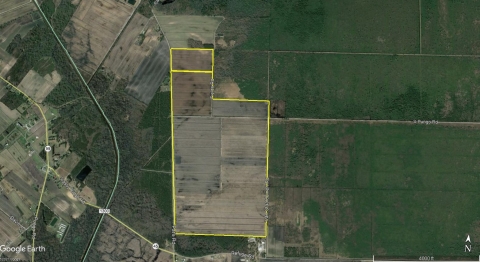
Farm #2445 consists of Tracts 3863 and 3874, totaling approximately 494 acres (Figure 1). More details on the fields included in the parcel are available. See map below for a general reference.
Figure 1: Farm #2445, Pat’s Road Fields
General Operating Requirements
Below are several operating requirements which will also be covered in detail in the Plan of Operations, Special Conditions, and General Conditions Sections.
- A Plan of Operations is required for addressing current objectives, opportunities, restrictions, and other details, and may be altered through consensus by both Refuge management and Cooperator. A sample Plan of Operations is available for review upon request.
- Cooperator agrees to a percentage crop share-split of farmed acres that will be 80%, with an additional 25 acres of winter wheat to be planted as a cover crop. The Refuge share of the crops will be left in the field with crop type and locations to be determined by the Refuge Representative.
- Use of genetically engineered crops (GECs) is authorized. GEC use on the refuge must follow refuge policy, Best Management Practices (BMPs), and all required regulations pertaining to the use of GECs.
- ALL pesticide use must be pre-approved under a Pesticide Use Proposal (PUP). An approved list of pesticides will be supplied to the cooperator as well as any Best Management Practices (BMPs) that are conditions to an approved PUP and must be followed. Use of neonicotinoid pesticides, including seed treatments, has not been approved recently. The list for 2024 is still in the approval stage. For an idea of what pesticides may be approved and their associated restrictions, the approved list of pesticides and their BMPs for 2023 is available upon request. Cooperators are expected to maintain v-ditches and sides of collector canals on an annual basis.
- To facilitate flooding impoundments for waterfowl and reduce disturbance of waterfowl, crops should be harvested by November 1. De-watering of impoundments will begin in February, but fields could remain wet until mid-March.
- All liability relating to farming and crop management to include all persons working for the Cooperator, whether related, hired, or as a partner is strictly that of the Cooperator.
- The Cooperator must have or acquire liability insurance that covers equipment used on Service lands.
- Farming privileges may not be sold, transferred, or sublet.
- Non-use of lands, in whole or in part unless agreed to by Refuge Representative in the Plan of Operations or at time of planting, shall be cause for cancellation of a Cooperator's privileges at the discretion of the Refuge Representative.
Cooperator Selection
The producer(s) will be selected through an open, transparent and competitive process where applications will be scored and ranked by the following objective criteria:
- Experience in cultivating the crops listed above, especially personal experience on NWR lands or comparable land, including intimate knowledge of soil composition, chemistry, moisture, and fertility, water needs, pest problems, and erosion problems.
- Demonstrated ability to successfully cultivate crops under the crop and chemical restrictions listed above (e.g. GECs, non-GECs, non-neonicotinoid pesticides, restricted timing of harvest, endangered species restrictions), following BMPs.
- Ownership or access to the proper equipment, materials, labor, or other resources to participate in the CAA.
- Experience in or willingness to use conservation practices such as cover crops, no-till, etc.
- In-kind services to assist the refuge in carrying out a successful cooperative agriculture program.
- Positive references regarding past performance, experience, abilities related to crop cultivation, and responsiveness to landowner requests.
Applications
Applicants must fill out applicable portions of FWS Form 3-1383-C and Bid Sheet 3-1384. The application form, bid sheet, and supplemental application instructions can be viewed below under "Get Started" or by hard copy at the Refuge. Applications can be submitted to the attention of Sarah Toner via email (sarah_toner@fws.gov), mail (Pocosin Lakes National Wildlife Refuge, PO Box 329, Columbia, NC 27925), or in person at the Refuge Headquarters (205 South Ludington Dr, Columbia, NC 27925). Applications will be accepted beginning January 19, 2024 and must be received by January 31, 2024 at 4:00 pm.All applications will be opened and evaluated, and the applicant with the highest ranked proposal will be notified by February 12 of their selection. Unsuccessful applicants will also be notified.
For requests for site visits or for additional information on the Cooperative Agriculture Agreement, please call Sarah Toner, Visitor Services Manager, at (252) 256-0316.
Audience
Get Started
Applicants must fill out applicable portions of FWS Form 3-1383-C and Bid Sheet 3-1384. If necessary, you may attach additional sheets to answer the questions in the application. Please see additional instructions below for filling out Form 3-1383-C.
Applications can be submitted to the attention of Sarah Toner via email (sarah_toner@fws.gov), mail (Pocosin Lakes National Wildlife Refuge, PO Box 329, Columbia, NC 27925), or in person at the Refuge Headquarters (205 South Ludington Dr, Columbia, NC 27925). Applications will be accepted beginning January 19, 2024 and must be received by January 31, 2024 at 4:00 pm.All applications will be opened and evaluated, and the applicant with the highest ranked proposal will be notified by February 12 of their selection. Unsuccessful applicants will also be notified.
Supplemental Instructions for Use of Form 3-1393-C for Applications for Cooperative Agriculture Opportunities on National Wildlife Refuges
PLEASE READ THE FOLLOWING CAREFULLY BEFORE FILLING OUT THE APPLICATION:
- FORM 3-1383-C (Commercial Special Use Permit) is used by the US Fish and Wildlife Service (Service) for applications for cooperative agriculture opportunities as well as for formalizing the Cooperative Agriculture Agreement on the Refuge.
- Applicant Information: Farming privileges may not be sold, transferred, or sublet. Only one name/business name should appear as Producer on the Farm Services Agency FSA-587 Report of Commodities.
- At the time of application, the applicant does not need to complete all sections of the Commercial Special Use Permit, but does need to ensure that they provide sufficient information on their proposed operations for the Service to rank and score your application based on the objective criteria listed in the Service’s Notice of Cooperative Agricultural Opportunity (Notice).
- In addition to providing the Service detailed information about your proposed agriculture practices on the refuge, you must also describe how your proposed activity, based on your background, knowledge and experience, meets the objective criteria by which the Service will evaluate your application as outlined in the Service’s Notice. In addition, if applicable, please identify how your proposed activity is different from the description of the cooperative agricultural opportunity outlined in the Notice. Due to the limited space on the 3-1383-C Form, please use the Bid Sheet to provide this additional information.
- Bid Sheet should be attached to Form 3-1383-C as part of your application package.
- Write N/A in any sections that do not appear to be relevant.
- Both the Plan of Operations (Section 18) and Logistics and Transportations (Sections 24a through 30) only need to be completed if you are selected as the Cooperator. These sections will then be completed in coordination with Refuge management prior to any agriculture practices beginning on the Refuge.
- The signed and completed Commercial Special Use Permit will be the selected Cooperator’s authorization for access on and use of Refuge lands, resources and facilities.