


Julia Butler Hansen
Plan Your Visit
National Wildlife Refuges offer us all a chance to unplug from the stresses of daily life and reconnect with our natural surroundings. Change is constant and necessary at Julia Butler Hansen Refuge, providing new experiences with each visit. Daily and seasonal tides, seasons, weather patterns, life cycles and migrating animals all contribute to the consistent flow of opportunities.
The main unit of the refuge is located along Highway 4 in Cathlamet, WA. Coming from the East, it is approximately 2-miles past Cathlamet. Coming from the West, it is approximately 4-miles past Skamokawa. Turn onto Whitetail Rd to enter the refuge.
Activities


More Activities
Get Involved
Whether you want to further conservation through hands-on opportunities, learn more about nature by joining a program or event, or share your love of nature with our youngest generations, you’ve come to the right place!
National Wildlife Refuges provide many opportunities for you to get involved and help your community by doing what you love. We partner with other government agencies, non-profit organizations, volunteers, youth/community groups, school, landowners, and neighbors in order to successfully carryout our mission. Find out how you can help below!
Volunteering
Bring the skills you already have or learn some new ones by volunteering at the refuge complex. Many opportunities exist for you to donate your time and talents for conservation. Whether you want to give a few hours now or hope to participate in on-going activities, the refuge has projects for individuals and groups. Explore the list below for ways to support local wildlife and habitats.
Habitat Restoration
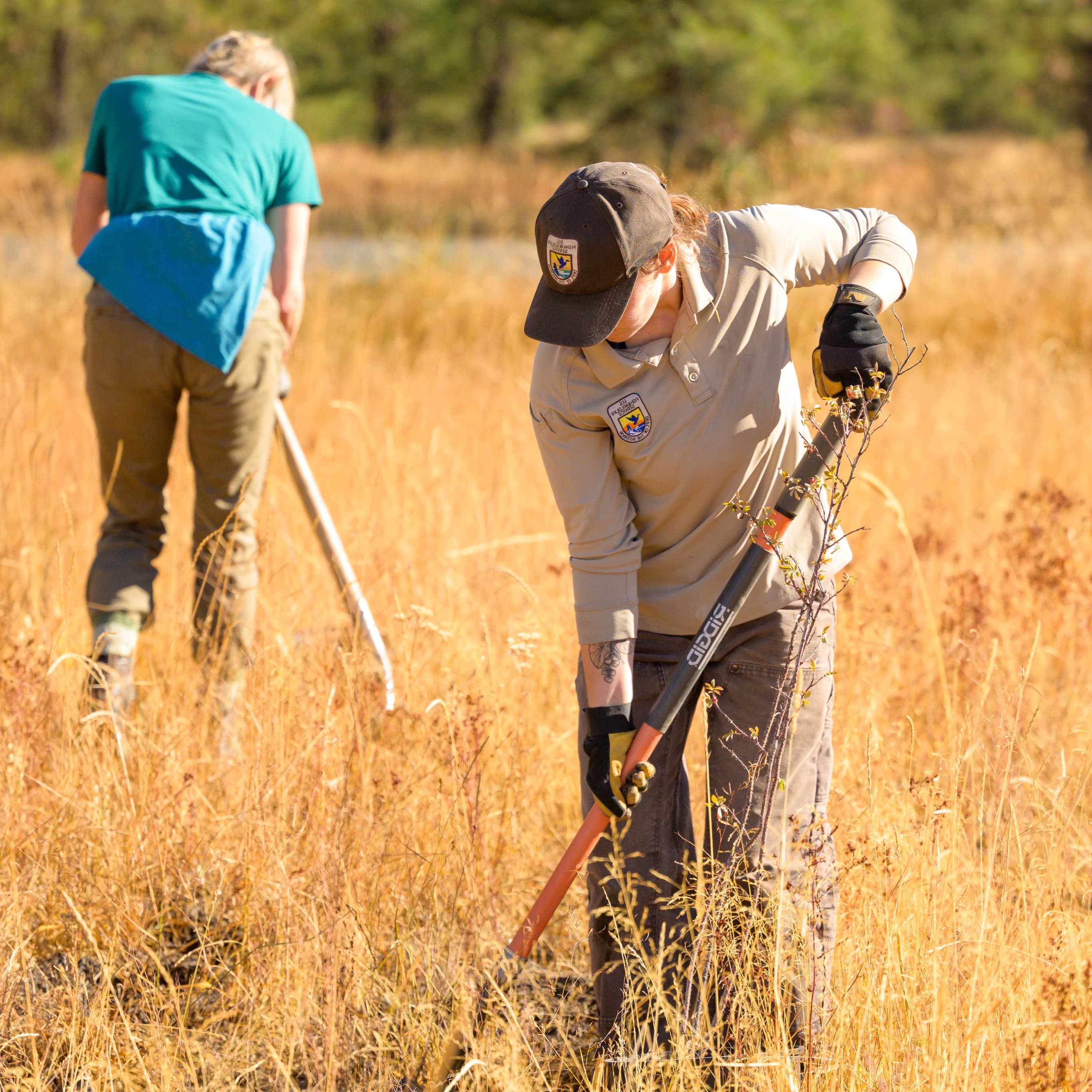
Invasive species are one of conservation's greatest struggles. Search for and pull invasive plants, and plant native plants! Several restoration projects need on-going plant removal. This opportunity often involves work days for a group of volunteers.
Trail Stewards
Our most flexible volunteer opportunity! Already hiking our trails? Report back to us about trail conditions, maintain interpretive signage, communicate with other refuge visitors, and more.
Facilities Maintenance
Buildings, sign and trails take effort to maintain. Help inventory and maintain refuge signs, keep our headquarters grounds looking great or donate your carpentry skills.
Excited by something on the list or have unique talents you want to share? Contact us at willapa@fws.gov.
Working with others to conserve, protect, and enhance fish, wildlife, plants, and their habitats for the continuing benefit of the American people.
Services
Julia Butler Hansen Refuge protects and manages habitats in order to conserve the Columbian white-tailed deer that rely on them. Much of this management work involves maintaining, enhancing, or restoring habitat using techniques such as mowing, tilling, seeding, and control of water levels.
What We Do
Julia Butler Hansen Refuge faces many unique management challenges. While the refuge includes many pristine areas, it also includes lands where considerable restoration effort is needed. With a diversity of habitats, an equal diversity of conservation efforts must be employed. The refuge is home to several threatened species, and is trying to restore habitat for many others. Like many places, this refuge is also coping with the threat of invasive species . To help plants and wildlife, refuge staff uses a variety of habitat management techniques to maintain, recover or enhance plant and wildlife values. Refuge staff carefully considers any management techniques and employ them in varying degrees according to the situation.
Sometimes, sensitive areas are closed to the public so that the land or species can recover more quickly. Mowing, tilling, seeding and the control of water levels are some of the techniques used to help native plants recover for the benefit of other wildlife. Mechanical removal or application of herbicides is also used to control invasive plant species, such as gorse, tansy ragwort and Scotch broom.
Standardized ground and aerial wildlife surveys and vegetation surveys are conducted on the refuge throughout the year to inventory populations and document habitat use. Units are evaluated by how well they met habitat and wildlife use objectives.
Public involvement and input are important to us and to the planning process, and we hope you will take an active interest in the process, individually and as a community.
Management and Conservation
Conservation efforts are guided and directed by the refuge's Comprehensive Conservation Plan which was approved in 2010. Goals include:
- Preserve the Columbian white-tailed deer in its natural habitat for future generations to see and enjoy.
- Providing viewing opportunities for the public to see this animal.
- Other wildlife of values: waterfowl, band-tailed pigeons, and numerous other wildlife species associated with a river environment.
- A waterfowl use area, part of the overall Columbia River wintering area, which plays a major role in winter for the Pacific Flyway.
- Preserving the river bottom habitat for mammals and birds.
- Historic, current and proposed management practices for habitat including vegetation on the islands consisting of willow, black cottonwood, Sitka spruce, red alder, red osier dogwood, elderberry,
salmonberry, and other species. - Preserving the fishery identified including Chinook and coho salmon and steelhead.
- Preserving the sloughs within the area characterized by populations of warm water game fish including bass, black and white crappies, bluegill, yellow perch, etc., and various catfishes
Chronic Wasting Disease: - Although not currently found on or near the Refuge, Chronic Wasting Disease (CWD) is a fatal disease of the deer family (cervids) which includes Columbian white-tailed deer, black-tailed deer and elk.
About
Julia Butler Hansen Refuge was established in 1971 specifically to protect and manage the then endangered Columbian white-tailed deer. The refuge contains over 6,000 acres of pastures, forested tidal swamps, brushy woodlots, marshes and sloughs along the Columbia River in both Washington and Oregon. Diverse habitat that support deer also benefit a large variety of wintering and migratory birds, Roosevelt elk, river otter, reptiles and amphibians, and nesting bald eagles, great horned owls and osprey.
Julia Butler Hansen Refuge is one of over 560 sites in the National Wildlife Refuge System, and one of 56 sites established to benefit specific threatened and endangered species. Managed by the U.S. Fish and Wildlife Service, this system is a vital living heritage, conserving wildlife and habitat for people today and generations to come.
Our Mission
Julia Butler Hansen Refuge for the Columbian White-tailed Deer is a stronghold for the conservation of this once nearly extinct population. Columbian White-tailed deer and other wildlife thrive here in a mosaic of meadows, wetlands, and riparian forests characteristic of the lower Columbia river watershed. Natural processes and management activities support a broad range of native plants and wildlife from Sitka spruce swamps to wild salmon. Refuge staff work closely with a variety of partners, both on and off the refuge, to accomplish Refuge purposes and conservation goals.
Our History
Before the 1920's, much of the mainland and Tenasillahe Island were marshes flooded by the daily rising tides of the Columbia River. The Whakiakum Diking District was formed in the 1920's, at which time the area surrounding and including the now-refuge was diked and drained. These dikes converted wetlands into agricultural lands that were farmed for nearly fifty years until the establishment of the refuge.
The early planning history for protection of the CWT deer began in January 1940, with a report and a plan for the protection of deer habitat by J. Burton Lauckhart, a U.S. Fish and Wildlife Service game biologist. The brief report included purchasing lands for the protection of deer habitat. Nearly 25 years later, a formal discussion to preserve these lands within the Refuge System set the stage for cooperation in establishing protection for Columbian White-tailed deer habitat. The first parcel (totaling 845 acres) was purchased in December 1971, establishing the “Columbia White Tailed Deer Sanctuary.” By July 1972, the sanctuary had gained over 1,900 acres and was renamed the Columbian White-tailed Deer National Wildlife Refuge.
In 1988, the refuge was renamed the Julia Butler Hansen Refuge for the Columbia White-tailed Deer. This refuge is one of only three refuges in the National Wildlife Refuge System named after a woman. Julia Butler Hansen (1907-1988), born Julia Caroline Butler, June 14, 1907, in Portland, Oregon, USA, served as a member of the Unites States House of Representatives from 1960-1974. She represented Washington's Third Congressional District as a Democrat. She was the second woman and first Democratic woman elected to Congress from Washington. She is honored by the Julia Butler Hansen Refuge for the Columbian White-tailed Deer; the Julia Butler Hansen Elementary School in Olympia; and the Julia Butler Hansen Bridge connecting Cathlamet to Puget Island.

An environmental assessment was completed in June 1993. This Columbia River addition included 4,484 acres located in Columbia County, Oregon. During 1998, the addition of the Willamette Industries property to the refuge was approved. The purpose for this addition was specified as “…to preserve native spruce swamp habitat for the endangered Columbian white-tailed deer.” In 2001, the U.S. Fish and Wildlife Service modified the approved refuge boundary to include the addition of the Moores-Wright Tracts which included an estimated 264 acres. A memorandum of agreement was signed in August 2003 between the Bonneville Power Administration, Columbia Land Trust and the Service for the “Acquisition and Management of a Portion of Crims Island." Ultimately, the U.S. Fish and Wildlife Service assumed all management responsibilities of this land. In May 2004, the refuge received a large portion of Crims Island; approximately one-third of the island is still held in private ownership.
Julia Butler Hansen Refuge for the Columbian White-tailed Deer is managed as part of the Willapa National Wildlife Refuge Complex.
Other Facilities in this Complex
A National Wildlife Refuge Complex is an administrative grouping of two or more refuges, wildlife management areas or other refuge conservation areas that are primarily managed from a central office location. Refuges are grouped into a complex structure because they occur in a similar ecological region, such as a watershed or specific habitat type, and have a related purpose and management needs. Typically, a project leader oversees the general management of all refuges within the complex and refuge managers are responsible for operations at specific refuges. Supporting staff, composed of administrative, law enforcement, biology, visitor services, and maintenance professionals, are generally, but not always, centrally located and support all refuges within the complex.
The Willapa National Wildlife Refuge Complex consist of three refuges; Willapa National Wildlife Refuge, Julia Butler Hansen Refuge for the Columbian White-tailed Deer and Lewis and Clark National Wildlife Refuge.
The Complex Headquarters Office is located at 7112 67th Place, Long Beach, WA 98631.
