


Seasons of Wildlife
Nesting and Migration
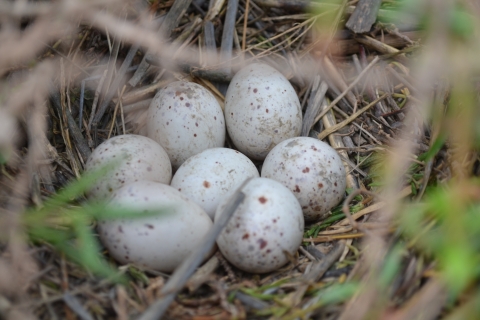
A small number of western snowy plovers nest in the river mouth areas and dunes from mid-March to mid-September, with peak nesting from April through June.
Belding’s savannah sparrows nest in higher salt marsh salt marsh
Salt marshes are found in tidal areas near the coast, where freshwater mixes with saltwater.
Learn more about salt marsh habitats, especially in pickleweed communities, from March to August.
Migration and Wintering Habitat
The Tijuana River Estuary lies along the Pacific Flyway, making it an important stop for migrating and wintering waterfowl and shorebirds. Winter visitors include pintail, cinnamon teal, American wigeon, surf scoter, and ruddy duck.
Shorebirds make up the majority of the migratory bird population. About 20 species occur regularly along the sandflats and mudflats, but four species—willet, dowitcher, western sandpiper, and marbled godwit—account for most of the population throughout the year. Numbers and species vary seasonally, with intertidal sand and mudflats supporting the greatest diversity.
Featured Species

Birds of Tijuana Estuary
Birds are a major reason for the special protection status of the Tijuana Estuary. More than 370 species have been recorded here, making it one of the most important bird habitats in Southern California.
Birds use a variety of habitats in the estuary, including ocean beaches and dunes, mudflats, salt marshes, and riparian riparian
Definition of riparian habitat or riparian areas.
Learn more about riparian areas. A complete bird list is available at the Visitor Center.
Threatened and Endangered Species
Five federally listed birds regularly occur in the Reserve:
- Light-footed Ridgway’s rail
- California least tern
- Least Bell’s vireo
- California gnatcatcher
Western snowy plover
In addition, Belding’s savannah sparrow is listed as endangered by the State of California. Other rare species include elegant tern, black skimmer, and northern harrier. Several of these species nest within the estuary.
Conservation Challenges
- Ridgway’s rail populations have declined due to loss of coastal salt marsh salt marsh
Salt marshes are found in tidal areas near the coast, where freshwater mixes with saltwater.
Learn more about salt marsh . In 2012, only 520 pairs were recorded across Southern California. - California least terns nest on beaches and dunes but face threats from predators and human disturbance. In 2006, 305 pairs nested here, producing 57–80 fledglings.
- Western snowy plovers nest from March to September and are highly vulnerable to predators and beach activity.
- Belding’s savannah sparrows nest in pickleweed marshes from March to August and are sensitive to disturbance.
- Least Bell’s vireo nests in willow thickets along streams and channels in the Reserve.
Migration and Wintering Habitat
The estuary lies along the Pacific Flyway, providing critical habitat for migrating and wintering waterfowl and shorebirds. Winter visitors include pintail, cinnamon teal, American wigeon, surf scoter, and ruddy duck.
Shorebirds are abundant, with species like willet, dowitcher, western sandpiper, and marbled godwit making up most of the population. Numbers and species vary seasonally, with mudflats and sandflats supporting the greatest diversity.