


Volunteering
Volunteering for the U.S. Fish and Wildlife Service is fun and rewarding in many ways. Master new skills. Meet new friends. Enjoy a sense of accomplishment from doing your part to further wildlife conservation for the pleasure of generations to follow.
The refuge’s diverse programs utilize volunteers of all ages and abilities. Common volunteer activities include staffing the visitor centers, helping with guided tours, developing outreach and informational materials, and maintaining grounds, trails, and signs. At times, volunteers may be invited to help with biological surveys or other one-time volunteer events. Whether the jobs are labor intensive projects for scout or church groups, full-time internships, or regular weekly or monthly assistance, there are always needs in the various refuge program areas. Even if you can't come to one of the refuges in person, you might be able to help by being a Volunteer from a Distance. There may be web-related or non-internet related writing projects that need assistance. Contact Sarah Toner, sarah_toner@fws.gov to learn more!
Resident Volunteers
The Coastal North Carolina National Wildlife Refuge locations listed below are seeking Resident Volunteers to assist with visitor services, refuge maintenance, and seasonal operations. The refuges are located from the Atlantic Coast to the Albemarle–Pamlico Peninsula in Dare, Hyde, and Tyrrell Counties, NC.
You can expect scenic surroundings with abundant wildlife. These locations offer a peaceful, nature-rich place to stay while contributing to the mission of protecting wildlife and habitat in Eastern Coastal North Carolina. We are grateful for the time and energy our volunteers bring to all of our National Wildlife Refuge locations to support the Fish and Wildlife Service.
Openings
Alligator River National Wildlife Refuge, East Lake, North Carolina
May 11, 2026 to December 2026
Pea Island National Wildlife Refuge, Rodanthe, North Carolina
June 1, 2026 to December, 2026
Pocosin Lakes National Wildlife Refuge, Columbia, North Carolina
April 1, 2026 to December 2026
Mattamuskeet National Wildlife Refuge, Hyde County, North Carolina
May 1, 2026 to December 2026
Duties
Resident Volunteers may assist with:
- Visitor center or contact station support
- Light facility or grounds maintenance
- Environmental education and interpretation
- Outreach and public engagement
- Support for biological or wildlife management activities (seasonal)
- Assist in cleaning the visitor center
Housing
Volunteers live in their own recreational vehicle on refuge-provided RV sites. Provided amenities include:
- 30/50 amp electrical hook-up
- Water and sewer hook-up
- Access to laundry facilities
Commitment
- Couples: 24 hours per week (each)
- Singles: 32 hours per week
- Minimum stay: 3 months preferred
- Shorter terms may be negotiated
- Longer terms may be offered based on need and availability
Requirements
- Must provide your own RV
- Ability to work independently and as part of a team
- Willingness to interact with the public when assigned visitor duties
Ability to perform light physical tasks as needed (duties vary by season)
For more information please send your contact details, background, experience and availability to Sarah Toner, sarah_toner@fws.gov.
Internships
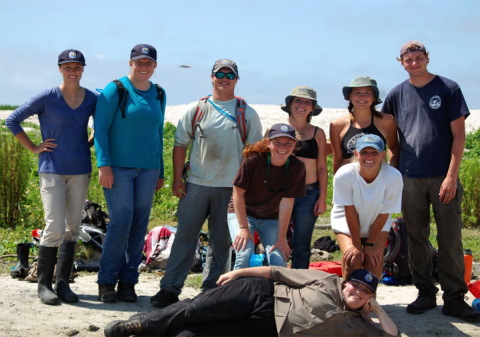
Refuges in the Coastal North Carolina National Wildlife Refuge Complex offer a variety of internships. In addition to internships at Alligator River NWR, Pocosin Lakes NWR and Mattamuskeet NWR also offer internship experiences.
Alligator River and Pea Island NWR Internships
The refuge’s intern program provides unique experiences for college students and graduates geared towards careers in the environmental sciences. Internships expose interns to many aspects of managing a refuge by rotations through different program areas. Interns assist with visitor services, biological monitoring, and maintenance activities. Interns present public outreach programs such as guided canoe tours and open-air tram tours as well as educational programs on species such as black bears and sea turtles. They also help staff visitor centers as needed. Biological duties include installing beach nesting bird protection areas, mapping and treating invasive plant species, sea turtle monitoring, shorebird surveys and water level monitoring. All interns assist with refuge maintenance duties, including mowing, trimming, trail work, sign maintenance, stocking refuge brochures, trash and recycling collection and assisting other staff with a variety of projects.
Interns will receive on-the-ground training for all duties, including the safe operation of ATV/UTV's, mower use, and field safety. Interns work independently, in pairs, or with refuge staff or volunteers. Physical requirements can include the ability to lift and paddle canoes, carry up to 40 pounds in the sand, and walking miles in the sand with outside air temperatures in the upper 80’s in humid conditions.
All applicants must possess a valid driver’s license and have maintained it for at least one year. A refuge vehicle will be provided for work duties. A personal vehicle is required for transport from housing to the refuge office.
We seek enthusiastic team members! It is more important for us to find candidates with good references and positive attitudes than previous technical experience.
The internship runs from May 18th through August 7th, 2026. Interns will be expected to commit for the full 12 weeks. In your application, please state your dates of availability if different from the internship dates. Extended periods of leave during the internship term may not be granted.
Interns typically work 40 hour weeks. Weekend work will be required; however, interns are guaranteed two days off a week.
We may ask one or two of our summer interns to extend through October to assist with fall biology work and the Wings Over Water Wildlife Festival.
To Apply
Summer 2026 applications have closed. Applications were accepted until January 6, 2026.
You will increase your chance of being selected if you’re open to internships at any of the three duty stations in eastern North Carolina (Alligator River and Pea Island National Wildlife Refuges, Pocosin Lakes National Wildlife Refuge, and Mattamuskeet National Wildlife Refuge). In most cases, to be considered for an internship position, an applicant must be able to stay a minimum of three months.
Internships are volunteer positions. Housing and a living allowance are provided. The living allowance consists of $200 per week (paid biweekly) and an additional $1200 paid upon completion of the full 12 weeks of the internship.
To apply, mail a resume, contact information for three references, and a cover letter indicating your specific interests and dates available to Sarah Toner, sarah_toner@fws.gov. In your application, indicate your specific interests and describe your background and experience relating to the following:
- Wildlife identification and surveys
- Outdoor field work
- Public interpretive programs and presentations
- Communication with a range of audiences
- Navigating outdoors and orienteering
- Canoeing
- Operation of ATVs & UTVs
- Maintenance (trail and other)
- Using hand tools, power tools, and riding mowers
Make sure to provide your dates of availability!
Volunteer Opportunities
Our Partners
Nature does not recognize human-made boundaries. In order to conserve our natural and cultural resources effectively, we must work with others to bridge these boundaries. Partnerships foster creative solutions to challenging situations and often the results are greater than the sum of the parts.






Outreach
Junior Duck Stamp Art Contest
Staff member Sarah Toner is the North Carolina Coordinator for the U.S. Fish and Wildlife Service Junior Duck Stamp Program. As coordinator, Sarah provides programs detailing the program and oversees North Carolina entries in the Junior Duck Stamp Art Contest.
The Junior Duck Stamp Conservation and Design Program is a dynamic, art and science program designed to teach wetlands habitat and waterfowl conservation to students in kindergarten through high school and help reconnect youth with the outdoors. The program guides students, using scientific and wildlife observation principles, to communicate visually what they have learned through an entry into the Junior Duck Stamp art contest. This non-traditional pairing of subjects brings new interest to both the sciences and the arts. It crosses cultural, ethnic, social and geographic boundaries to teach greater awareness of our nation's natural resources. The Junior Duck Stamp Program exposes hundreds of thousands of youth each year to wetlands, National Wildlife Refuges, and art concepts.
Part of this program is an art contest open to K-12 students attending public, private, or home schools in the United States and the U.S. Territories. Children are eligible to enter, as long as they are U.S. Citizens, resident aliens, or nationals. U.S. Citizens attending schools abroad may enter through their legal state of residence. The Junior Duck Stamp Design Contest is the culmination of the Junior Duck Stamp educational program. After studying waterfowl anatomy and habitat, students may articulate their newfound knowledge by drawing, painting or sketching a picture of an eligible North American waterfowl species. Students from around the United States submit drawings to their state, territory or district competition. Winners from these competitions, called the "Best of Show," are then submitted to the Federal Junior Duck Stamp Design Contest. One image from the 54 Best of Show entries will become the next Junior Duck Stamp. Junior Duck Stamps are sold for $5 each by the U.S. Postal Service, Amplex Corporation, and various National Wildlife Refuges. Proceeds from the sale of Junior Duck Stamps are returned to states for environmental and conservation education programs.
The U.S. Fish and Wildlife Service have designed an education curriculum to go along with this program. You may download the Junior Duck Stamp Education Curriculum online or you may contact Sarah to receive a printed or electronic disk version of the curriculum.
For more information on the Junior Duck Stamp Program, the art contest, or educational curriculum contact Sarah Toner.