A resource for people and their environment
Chesapeake Bay Field Office Hosts Chinese Conservation Delegation
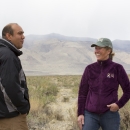
Sherry Krest shows deformed frogs to Chinese delegation. Photo by Laurie Hewitt, USFWS
 |
Environmental professionals from China’s Guangdong Province Forestry Ministry visited the Chesapeake Bay Field Office, organized by the Service’s Division of International Conservation. An open forum provided the backdrop for the exchange of information in the field of fish and wildlife conservation, management and natural area protection.
Chesapeake Bay Field Office staff highlighted some of the tools and techniques used to protect lands, restore steams, wetlands and other critical habitats, protect endangered species and provide fish passage which the delegation found very useful for their goals.
"I was very impressed by the scientific robustness of the presentations by the Chesapeake Bay Field Office, commented Bryan Arroyo, Assistant Director Fisheries and Habitat Conservation. “The Field Office and Fisheries staff provided great presentations and our guests were most impressed with their professionalism and technical capacity."
Situated in the southernmost part of mainland China, the hills and mountains of the Guangdong Province had been covered by forests. In 1985, a "green revolution" began and all the forestless mountains had been afforested, through the work of the Guangdong Province Forestry Ministry. Today this work continues with sustainable the multi-purpose forestry and natural resource management.
This visit is part of a larger effort by the Service known as the China Program where wildlife managers from both countries exchange information and specialists to address wildlife trade issues, and wetlands, river, and floodplain management.
This was the Chinese group’s second visit to the Chesapeake Bay area in recent years. In May of 2009, the Chesapeake Bay Field Office hosted a Chinese delegation which learned about and then toured the protected and restored habitats around the Chesapeake Bay watershed.
In September 2009 the Guangdong Province Forestry Ministry co-hosted a group of Service specialists including, Chesapeake Bay Field Office Supervisor Leopoldo Miranda, to learn about China’s wetland restoration and management programs.
"I think that this kind of international exchange and information sharing helps us see different approaches and learn new ways of protecting and managing our fish and wildlife resources,” concluded Leopoldo Miranda, Supervisor Chesapeake Bay Field Office.
To see more about:
The Guongdong Province, visit: www.gdf.gov.cn/english
The China Program, visit: www.fws.gov/international/DIC/regional%20programs/china/china.html
Coastal Program Conservation Partnerships Awarded National Coastal Wetlands Grants
Cedar Island. Photo by Dan Murphy
 |
Two 2010 National Coastal Wetlands Grants (NCWG) have been awarded to conservation partnerships led by the Chesapeake Bay Field Office (CBFO) Coastal Program. A total of 570 acres of Delmarva Peninsula wetlands and forests will be protected using $1,072,610 in NCWG funds leveraged by a combination of State funds and landowner contributions totaling $1,116,390.
Cedar Island Coastal Wetland Protection - The Maryland Department of Natural Resources (MDNR) was awarded $207,760 to acquire 200 acres in Somerset County, including 192 acres of estuarine salt marsh located on Tangier and Pocomoke Sounds on the Chesapeake Bay. These funds will leverage $216,240 of non-Federal cost share. This parcel will be incorporated into the adjacent 3,000-acre Cedar Island Wildlife Management Area, completing the protection of the entire island. Located in the Atlantic Coast Joint Venture's Tangier Sound and Bay Islands sub-focus area, Pocomoke Sound and Cedar Island support some of the best remaining beds of submerged aquatic vegetation in Maryland and are considered to be important for breeding black duck. Partners in the project include the USFWS CBFO Coastal Program and the Lower Shore Land Trust.
South Point Property and Croppers Island Conservation Easements - The MDNR was awarded $864,850 to acquire conservation easements on the 160-acre South Point property and the 210-acre Croppers Island property in Worcester County along Ayers Creek and Newport Bay. These funds will leverage $900,150 in non-Federal cost share. Both properties are located within the 153,000-acre Maryland Atlantic Coastal Bays watershed. The acquisitions will protect 1.5 miles of shoreline on Newport Bay, 163 acres of estuarine intertidal and palustrine forested coastal wetlands, 92 acres of native coastal plain forest, habitat for breeding and wintering waterfowl, breeding habitat for water birds and shorebirds, and stop-over habitat for migrating birds. Twenty-four acres of wetlands will be restored through the Conservation Reserve Enhancement Program. Partners in the project include the USFWS CBFO Coastal Program, the Lower Shore Land Trust, Worcester County, and the Natural Resources Conservation Service.
Waterbirds and Offshore Wind Energy Development
Interactions, Studies, Monitoring, and Mitigation
Northern Gannets. Photo by Michael Haferkamp
 |
There is a great push for offshore wind energy along the East Coast states, especially over the shoals. These shoals are also important feeding and migration areas for many marine birds. Over 72 species of birds use these areas for some part of their life cycle. Doug Forsell, Coastal Program biologist with the U.S. Fish and Wildlife Service’s Chesapeake Bay Field Office, examines offshore wind energy, the possible effects on marine birds, methods for studying and monitoring marine birds, their behavior and habitats, and possible mitigation for offshore wind energy.
To view the entire seminar, go to:
http://67.202.209.147/launcher.cgi?room=R5ROSS1_2009_1008_1205_28
Login as a participant using your name (no password) Run Setup Wizard on website if you are a first-time user of the system
Living Shoreline Protects Fragile Eastern Neck Habitat
CBFO biologist Mitch Keiler plants bay grass with local children. Photo by Jennifer Greiner
 |
The Hail Cove Living Shoreline Project, at Eastern Neck National Wildlife Refuge in Kent County, Maryland, demonstrates an alternative to traditional shoreline protection revetment practices that nearly eliminate important shallow water habitat.
Eastern Neck National Wildlife Refuge is a 2,286-acre stopover area for migratory and wintering waterfowl at the mouth of the Chester River on Maryland's Eastern Shore. Within Eastern Neck is Hail Cove which separates the Chester River and Hail Creek. Hail Cove is regarded as one of the five best waterfowl habitats in Maryland.
Aerial surveys over the past 10 years revealed the importance of protecting Hail Creek from damaging erosion due to prevailing winds. Protecting Hail Cove will preserve submerged aquatic vegetation that is so critical to migratory waterfowl. The living shoreline will also reduce shore erosion and create marsh and reef habitat for Chesapeake Bay wildlife such as blue crabs, diamondback terrapins, fish, oysters and mussels.
On August 12, 2009, President Obama signed an executive order, Chesapeake Bay Protection and Restoration that calls on the federal government to lead the effort to control pollution that flows into the Chesapeake Bay and protect wildlife habitats in the region.
It directs federal agencies to work with State and local government as well as the private sector and use their expertise to improve the health of the Chesapeake Bay. Hail Cove shows how this collaboration can work to protect and restore the Chesapeake Bay.
The Hail Cove project represents a collaborative effort between government agencies, non-profit organizations and the private sector to protect and enhance valuable resources. The work at the site is focused on the protection of these important resources for years to come. For much more information visit our Hail Cove page.
For more information contact:
David Sutherland
410/573-4535
david_sutherland@fws.gov
Dan Murphy, CBFO biologist. VOA photo
 |
Voice Of America Highlights Nutria Efforts
Voice of America recently followed Chesapeake Bay Field Office and USDA biologists as they assessed the successful nutria eradication program on Maryland's eastern shore.
Nutria were introduced from South America in the 1930s to bolster Maryland's fur industry. This aquatic rodent uses marsh plants to create resting platforms as well as eats these plants, creating huge mud flats. The voracious nutria has been responsible for wetland loss in many areas on lower eastern shore marshes, especially Blackwater National Wildlife Refuge.
Aerial photos from 1938 to present show an alarming loss of marsh, escalating over the past two decades, coinciding with nutria population explosion.
In 1995, a partnership between 24 federal and state agencies, private organizations, businesses and landowners was formed to stop nutria damage.
Watch the Voice of America video, or read the article to learn more.
Eagle chick found in the new nest. Photo by Craig Koppie, USFWS
 |
Update!
Eagles Removed From Airport Doing Well
Back in February 2009, the U.S. Fish and Wildlife Service, along with officials of the Airport Management Authority and the USDA’s Animal Plant Health Inspection Service (APHIS), determined that a bald eagle pair nesting along an active runway at Glenn Martin State Airport, near the town of Essex MD could be a hazard to airport safety.
With assistance from Airport Operations, the U. S. Fish and Wildlife Service removed the eagle nest from a tree located near the active runway fearing a potential mid-air collision with local aircraft.
The pair had just begun to lay eggs that week. However, because it was still early in the nesting season, biologists expected the bald eagle pair would have time to construct a new nest or would relocate to an alternate nest location.
Two weeks after the disturbance, Chesapeake Bay Field Office biologist Craig Koppie, checked the pair’s old nest located closer to the Frog Mortar Creek. The adult female was standing on the nest which was a good indicator she was planning to re-use their old nest site. On July 7th, he revisited the nest tree and found she had produced two eaglets which look to be about 8-9 weeks old! The young will probably take their first flights when they reach 11 weeks of age. Most all other eaglets in the Chesapeake Bay have fledged by now.
Al Rizzo of CBFO wins Wetland Warrior award from
Delaware Dept. of Natural Resources and Environmental Control.
 |
Delaware Presents 2009 Wetland Warrior Award to CBFO Partners for Fish and Wildlife Coordinator
July 30, 2009
Delaware Governor Jack Markell and Delaware Department of Natural Resources and Environmental Control Secretary Collin O’Mara presented Al Rizzo, soil scientist and Partners for Fish and Wildlife Coordinator for Delaware and Maryland, with the 2009 The Wetland Warrior Award. The award is presented to an individual or group in recognition of exemplary efforts that benefit wetlands through education and outreach, monitoring and assessment, or restoration and protection.
Read more about the achievements that made Al a Wetland Warrior.
Also, read the press release from the state of Delaware.
Box turtle. Photo by Frank Marsden
 |
Excellent Schoolyard Habitats Share These Qualities!
Schoolyard habitats are naturalized areas on school grounds accessible to the entire school community. Excellent schoolyard habitats improve community health by reducing storm water runoff, solving erosion and increasing biodiversity. They also provide opportunities for children to interact with the natural world. To help guide the creation of excellent schoolyard habitats the Maryland Schoolyard Habitat Partnership developed “Common Qualities of Excellent Schoolyard Habitat.”
Or, read the press release....
Chesapeake Bay Welcomes Natural Resource Officials from China
On May 8, eleven Chinese natural resources officials visited the Chesapeake Bay Field Office. Their goal was to gain a better understanding of the wetland laws and policies, how we use these laws to benefit wetlands and how we monitor wetland restoration. This visit was facilitated under U.S. – People’s Republic of China (PRC) Protocol on Cooperation and Exchanges in the Field of Conservation of Nature, signed in 1986.
Find out where they went and what they did . . .
A new tool to view sea-level rise simulations is available
Migratory birds nesting habitats could be affected by sea-level rise. Credit: Leopoldo Miranda / USFWS
 |
As the globe warms and polar ice caps melt, sea levels rise, causing the flooding of coastal marshes, important for wintering mallard ducks, and eroding coastal beaches, vital as refueling stops for migrating song birds.
To plan for sea-level rise, the National Wildlife Refuge System uses various models to understand how advancing seas will affect coastal marshes, tidal flats, beaches and swamps. Among these models, the workhorse is SLAMM – Sea Level Affecting Marshes Model – which has been used extensively since 2006. Similar to a weather forecast, SLAMM is a useful tool to forecast habitat transformations as sea levels rise.
Visit our SLAMM-view page to find out more, and see how sea-level rise will affect your community.
Scientists Discover Intersex Fish More Widespread
Smallmouth bass. Illustration by Timothy Knepp, USFWS.
 |
Annapolis, Maryland - A recent study of intersex abnormalities in fish conducted by researchers from the U.S. Fish and Wildlife Service and the U.S. Geological Survey in the Potomac River watershed showed that at least 82 percent of male smallmouth bass and in 23 percent of the largemouth bass had immature female germ cells (oocytes) in their reproductive organs.
This condition, a type of intersex, is a disturbance in the fish’s hormonal system and is an indicator of exposure to estrogens or chemicals that mimic the activity of natural hormones. Several other abnormalities were also noted, some affecting female bass.
“At the moment we don’t know the ecological implications of this condition and it could potentially affect the reproductive capability of important sport fish species in the watershed,” said Leopoldo Miranda, Supervisor of the U.S. Fish and Wildlife Service’s Chesapeake Bay Field Office.
For more information . .
New Report Shows Annual Loss of 59,000 Acres of Wetlands in Coastal Watersheds
While the nation as a whole gained wetlands from 1998 to 2004, a new report by the U.S. Fish and Wildlife Service and the National Oceanic and Atmospheric Administration documents a continuing loss of vital wetlands in coastal watersheds of the eastern United States.
The new report, Status and Trends of Wetlands in the Coastal Watersheds of the Eastern United States, shows an annual loss of 59,000 acres of wetlands in coastal watersheds of the Atlantic, Gulf of Mexico, and Great Lakes from 1998 to 2004.
Coastal wetlands are the nurseries for important commercial and recreational fish and are vital to many threatened and endangered species. They also provide natural protection for coastal areas from the most damaging effects of hurricanes and storm surges.
Through programs like Partners for Fish and Wildlife and the Coastal program, the Chesapeake Bay Field Office is restoring a variety of coastal habitats. One such project, restored 450 acres of salt marsh by plugging mosquito grid ditches at E.A.Vaughn Wildlife Management Area (WMA), located in Worcester County in the Maryland Coastal Bays region.
Read more about this exciting project . . .
The Department of Interior Supports Native Oyster Restoration
UPDATE! 4/4/09
Crassostrea ariakensis.
Photo by Julie Slacum, USFWS
|
The decrease in the native Eastern oyster (Crassostrea virginica) in the Chesapeake Bay can be attributed to three major factors: over-harvesting, disease, and habitat loss. Due to the decrease in native oysters, the states of Maryland and Virginia proposed the introduction of a non-native species of oyster (Crassostrea ariakensis) into the Chesapeake Bay.
In response to this proposal, the U.S. Congress directed the U.S. Army Corps of Engineers to prepare a Programmatic Environmental Impact Statement (PEIS). A series of alternatives to this introduction were proposed ranging from taking no action at all, to introducing the non-native oysters and discontinuing native oyster restoration.
The Department of the Interior has reviewed the Draft Programmatic Environmental Impact Statement (DPEIS) for Oyster Restoration in the Chesapeake Bay, Including the Use of a Native and/or Non-native Oysters and provided the following summary comments:
The Department remains concerned that if the preferred alternative in the final EIS includes the use non-native Suminoe oyster it is unlikely that the goal to restore the ecological and economic function of the Native oyster could be achieved. In addition, use of non-native Suminoe oyster alternatives will permanently interfere with restoration efforts using the native Eastern Oyster.
The Department believes that the best strategies for restoring the function of native Eastern oysters are to use a combination of native Eastern oyster alternatives identified in the PEIS. This combination includes expanding oyster restoration using native Eastern oysters, expanding native Eastern oyster cultivation in aquaculture in both Virginia and Maryland, and expansion of native Eastern oyster sanctuaries, coupled with greater enforcement of sustainable harvest limits.
A PDF copy of the letter is available here.
CBFO's Field Supervisor responds to the Washington Post article "Oyster Decision Could Alter the Bay" (2/15/09).
Restoring the Resources
 Credit: USFWS
Restored wetland along the Mispillion River in Delaware |
Along the Mispillion River in Kent County, Delaware, an eroded, degraded marsh has been transformed into vital habitat for local wildlife. The 56-acre private site consists of one of the river’s original meanders and associated wetland with more than 2,000 feet of river frontage. On October 2, representatives from the public-private partnership that made the project possible gathered to celebrate its success with a tour of the site.
This restoration, which was completed in June, is a Natural Resource Damage Assessment and Restoration (NRDAR) project for the DuPont Newport Superfund Site located in Wilmington, Delaware. The Trustees, Delaware Department of Natural Resources and Environmental Control (DNREC), National Oceanic and Atmospheric Administration (NOAA), and the U.S. Fish and Wildlife Service (US FWS), were authorized to recover damages to trust resources associated with a release of a hazardous waste at the NewPort site. Read more . . .
If you have questions or comments about this website, contact the Web Manager. |