Kris Budd
Fish and Wildlife Biologist
Ecological Services
Additional Role(s)
Missouri Dkey Sponsor
Expertise
Geographic Information Systems (GIS),
Determination Keys
Area
MO
Columbia,MO
Official websites use .gov
A .gov website belongs to an official government organization in the United States.
Secure .gov websites use HTTPS
A lock ( ) or https:// means you’ve safely connected to the .gov website. Share sensitive information only on official, secure websites.
These shapefiles and KMZ reflect tree removal thresholds and No Effect Zones for the Indiana bat, Northern Long-eared Bat, and Tricolored Bat according to forest cover within 5x5 km grid cell(s) intersected by the project.
Even when activities impacting suitable roost trees are conducted during the inactive season, Indiana bats, northern long-eared bats and tricolored bats may be adversely affected if roosting and foraging habitat is substantially reduced. Bats that return to their summer roosting area and find it removed must find new roost trees (Kurta and Rice 2002) and potentially new foraging areas. This extra energy expenditure could reduce an individual’s ability to carry out necessary functions after migration (such as thermoregulation during cool spring weather or gestation) or cope with other stressors (such as unseasonably cold temperatures or white-nose syndrome).
To ensure actions with potential to substantially reduce roosting and foraging habitat do not reach NLAA outcomes within the Missouri Dkey, we identified tree removal thresholds that when exceeded May Affect, Likely to Adversely Affect the corresponding species. In the Missouri Dkey, this results in a "May Affect" determination warranting further biologist review. Because there is a higher probability of impacting roosting or foraging habitat in areas with little forest or highly fragmented forests, the thresholds differ based on the amounts of forest cover within the area surrounding the project. We expect that actions not exceeding the relevant tree removal thresholds will not meaningfully reduce roosting and foraging habitat.
Tree removal thresholds for the Indiana bat, northern long-eared bat (NLEB), and tricolored bat (TCB) given the percent of forest cover within 5x5 km grid cell(s) intersected by the project.
| Surrounding Percent of Forest Cover | Tree Removal Thresholds for the Indiana Bat (acres) | Tree Removal Thresholds for the NLEB and TCB (acres) |
| 0 - 9.9% | ≤ 5 | ≤ 5 |
| 10.0 - 19.9% | ≤ 10 | ≤ 10 |
| 20.0 - 29.9% | ≤ 20 | ≤ 40 |
| 30.0 - 49.9% | ≤ 30 | ≤ 100 |
| 50.0 - 100% | ≤ 50 | ≤ 100 |
To determine if the relevant tree removal threshold will be exceeded, the Missouri Dkey will ask the acreage of trees that will be removed, and the response is compared with embedded GIS data used by the key.
No Effect Zones: Extensive bat surveys have been conducted within portions of the Kansas City and St. Louis metropolitan areas. The lack of gray bat, Indiana bat, and NLEB detections within these areas indicate the likelihood of the species’ presence is very low. Although the TCB has been occasionally documented within metropolitan areas, acoustic surveys indicate the species also has a low likelihood of presence within the areas.Therefore, a NE determination for each of the bat species is appropriate for actions located within these areas, regardless of the extent and timing of tree removal.
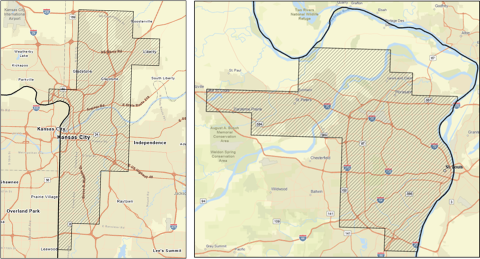
For grids outside of a species' area of influence, the shapefiles show an automatic "No Effect" instead of a designated acreage threshold.