US Fish and Wildlife Logo National Wildlife Refuge logo Big Lake NWR header
Blue rule lines graphic

Big Lake National Wildlife Refuge

Central Arkansas Refuges

Keith Weaver
Project Leader
Jonathan Windley
Deputy Project Leader
26320 Highway 33 South
Augusta, AR 72006
870-347-2614
Fax: 870-347-2908
Jeremy Bennett
Refuge Manager, Big Lake
PO Box 67
Manila, AR 72442
870-564-2429
Fax: 870-564-2573
E-mail: jeremy_bennett@fws.gov


paw imprint graphic Directions to Refuge & Map

paw imprint graphic Fact Sheet

paw imprint graphic General Brochure

paw imprint graphic Hunting Permit/Regulations


Tree

Fishing Pier

Flower

Sunrise

Lake

Birdbox

Refuge Facts

  • Established: 1915.
  • Acres: 11,038.
  • Located in Mississippi County, AR 18 miles west of the Mississippi River.
  • Other management: conservation easement--one in Green County; fee title tracts--two in three counties totaling 151 acres. Wilderness area of 2,100 acres. National Natural Landmark of 5,000 acres.
  • Location: the refuge is located on Highway 18, two miles east of Manila.

Natural History:

  • Refuge was once a portion of the Mississippi River, but now the Little River flows through it.
  • The New Madrid earthquakes of 1811-12 created the characteristics that made it a hunter/fisherman paradise. An extensive network of man-made ditches in the Missouri Bootheel drains approximately 2,000 square miles of farmland directly through the refuge detrimentally affecting the area.
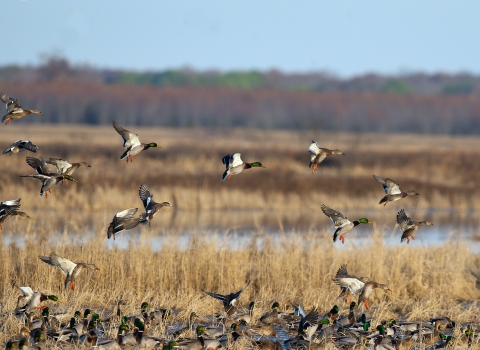
  • Concentrations of wintering and migrating ducks.
  • Bald eagle and osprey nests.
  • Swamp 5,250 acres; open water 2,600 acres; bottomland hardwoods; 2,100 acres; marsh 300 acres; moist soil plants 250 acres; cropland 32 acres.

Financial Impact of Refuge:

  • Two-person staff.
  • 35,000 visitors annually.
  • Current budget (FY 05) $266,000.

Refuge Objectives:

  • Provide habitat for wintering migratory waterfowl and other birds.
  • Provide habitat for nesting wood ducks.
  • Provide environmental education/ interpretation opportunities to the public.
  • Provide recreational (hunting, fishing, wildlife observation) opportunities for the public.

Management Tools:

  • Water management for waterfowl, marsh and water birds and shorebirds.
  • Forest management for neotropical birds.
  • Mechanical/chemical control of undesirable plants.
  • Farming.
  • Education/interpretation.
  • Law enforcement.
  • Partnerships.
  • Commercial fishing for roughfish.
  • Trapping to reduce problem beavers.

Public Use Opportunities:

  • Wildlife drive.
  • Observation point.
  • Wildlife observation.
  • Fishing.
  • Frogging.
  • Hunting.
  • Boating.
  • Photography.

Calendar of Events:

March-October: fishing.

April-October: frogging.

May: International Migratory Bird Day.

June: National Fishing Week.

September-October: squirrel hunting.

October: National Wildlife Week; raccoon hunting.

November-December: archery deer hunting.

Questions and Answers:

When does the fishing season open/ close?

The lake opens to the public on March 1 and closes on October 31.
When does the hunting season open?

Squirrel -- September 10 - October 31, 2005

Rabbitt -- September 3 - October 31, 2005

Raccoon -- October 8 - 23, 2005

Deer (archery) -- November 1 - December 31, 2005

Why is the lake so muddy?
Big Lake is part of an extensive drainage/flood control project which extends well into the bootheel of Missouri. Water from approximately 2500 square miles of intensively farmed land enters the refuge through a number of large manmade ditches. Significant rainfall events cause the watershed watershed to reach the refuge within 24 hours. Unfortunately, this fast moving water carries excessive amounts of trash, debris, and while we now have facilities in place to prevent trash and debris from entering the refuge, we still receive enormous amount of silt every year contributing to the muddy conditions frequently found on Big Lake. Unfortunately, the majority of the silt does not leave the refuge, it merely settles out on the bottom, where it can be stirred up by wind action. The most significant aspect of this silt is a rapid filling of the lake which impairs the growth of aquatic vegetation needed for fish and wildlife resources.
Where is the waterfowl hunting area?
No waterfowl hunting is permitted on Big Lake National Wildlife Refuge. For information on waterfowl hunting on the adjacent Big Lake Wildlife Management Area, contact the Arkansas Game and Fish Commission at 1/877 5438.
Why do you lower the lake levels during the summer?
The summer drawdown on Big Lake is a management tool designed to stimulate aquatic vegetation, and compact sediments in the shallow portions of the lake. Drawdowns begin in mid-July when the water is lowered until the maximum drawdown (approximately 1.5 feet) is reached. Water levelsx are held at this until mid-October when they are slowly raised until the maximum pool elevation is reached. Contrary to public perception this practice actually benefits the fish resources in the lake in a number of ways, including increasing the available food during the summer months, and improving spawning habitat. The resulting benefits for waterfowl are tremendous. The aquatic vegetation provides an abundance of natural foods for wintering concentrations of ducks and geese.
Do you allow camping?
Camping is not allowed on the refuge.
Discover American's Best Kept Secret National Wildlife Refuge banner

FWS Southeast Region Home | Privacy Information | Contact Us