States
Colorado, Kansas, New Mexico, Oklahoma, TexasLesser Prairie-Chicken
Tympanuchus pallidicinctus
- Range: The lesser prairie-chicken currently occupies a five-state range that includes portions of Colorado, Kansas, New Mexico, Oklahoma and Texas.
- Status: Under Review
About the lesser prairie-chicken
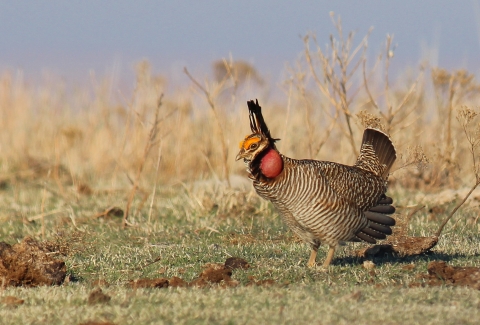
The lesser prairie-chicken is emblematic of the grasslands of the southwest, a treasured and storied American landscape of great importance to the people who call the area home. It is a species of prairie grouse commonly recognized for its colorful spring mating display and stout build.
While historical estimates suggest lesser prairie-chickens once numbered in the hundreds of thousands or even millions across nearly one hundred million acres, populations have declined drastically due to habitat loss and fragmentation. It is estimated that lesser prairie-chicken habitat has diminished across its historical range by about 90 percent.
Lesser prairie-chickens need large tracts of relatively intact native grasslands and prairies to thrive, and are considered a "boom-bust" species with annual reproductive success tied to precipitation patterns.
The Service, in cooperation with state wildlife agencies, private landowners and other partners, is working to conserve the lesser prairie-chicken and the native grasslands and prairies that support the species.
Listing Under the Endangered Species Act
The U.S. Fish and Wildlife Service listed two Distinct Population Segments (DPS) of the lesser prairie-chicken under the Endangered Species Act (ESA) in 2023.
In response to a court order, the U.S. Fish and Wildlife Service removed the northern and the southern distinct population segments of the lesser prairie-chicken from the federal list of threatened and endangered wildlife in 2026. As a result of the court's order, the regulatory protections under the Endangered Species Act no longer apply to either distinct population segment of the lesser prairie-chicken. A new 12-month petition finding process has been initiated.
Lesser Prairie-chicken Listing Decision Information
Partners in Lesser Prairie-Chicken Conservation
For over two decades, we've been working with our federal, state and private partners to facilitate the conservation of the lesser prairie-chicken and its habitat. These partnerships have resulted in a number of conservation efforts for the lesser prairie-chicken. Together we have made great strides, including raising awareness and conserving key habitat, but we still have a long way to go for a sustainable, long-term impact.
Learn more about these partnerships and agreements benefitting the lesser prairie-chicken.