


While wildlife comes first on all National Wildlife Refuges, we can also provide outdoor recreation, wildlife watching, and photography opportunities to our visitors—like the nature trails, observation towers and decks, and the Wildlife Drive here at Montezuma. The Wildlife Drive and Visitor Center are open annually from April 1 (weather-permitting) through November 30. Walking trails and observation areas are open year-round, with some trail closure during the white-tailed deer hunting season. Refuge visiting hours are sunrise to sunset; office hours are weekdays from 8:00 am to 4:00 pm; Visitor Center hours are daily, 10:00 am to 3 pm, April 1 - November 30.
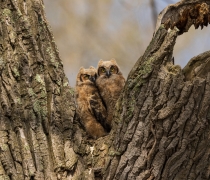
The Seneca Trail is now closed just past the public restrooms in order to abide by New York State wildlife protection laws.
A family of great-horned owls now has two fledged owlets. While these youngsters can fly, they are still learning and growing. This keeps them close to their nesting site. Because they are on the move, temporarily closing the area to visitors is necessary to cooperate with state laws and to give the owls the security they need to thrive. Please note, the Seneca Trail is also closed during the bald eagle nesting season for similar reasons. Please note and abide by closure signs, traffic signs (No Stopping or Standing) and barriers along the trails.
At the refuge, we work to strike a balance between wildlife well-being and visitor opportunities. During certain times of the year, this poses quite a challenge!
As great horned owls, bald eagles, and several species of songbirds continue their nesting seasons, we are counting on visitors to help safeguard their safety and well-being.Observing these magnificent creatures can be a memorable experience for all, but it's important to ensure their safety and habitat are not disrupted. There are several nests accessible for viewing from designated trails. This is exciting but is becoming disruptive.
To that end, we ask that visitors:
Avoid Being a Disturbance
Keep noise levels to a minimum and refrain from actions that may disturb or stress the wildlife.
Disturbing actions include:
- Approaching wildlife or even getting closer for a better look/photo. This not only scares the wildlife away but could leave a path or scent trail attractive to predators!
- Staying too long. Your presence stresses these attentive parents out!
- Baiting (with food, sound recordings, or vocalized calls). This is unethical and harmful to the birds and not legal on national wildlife refuges.
Stay in Your Car. This is a rule all along the Wildlife Drive.
For your safety and that of the wildlife, please observe from the shelter of your car. Remember, your car acts as a blind. The human figure is a threat to wildlife, and they use energy needed for survival to flee from you. You may only get out of your car at designated areas along the Wildlife Drive, marked with a brown and white binoculars sign.
Don’t Block Traffic
Please park responsibly, ensuring that traffic flow is not obstructed and emergency access routes remain clear.
Visit Us
National wildlife refuges offer us all a chance to unplug from the stresses of daily life and reconnect with our natural surroundings. Montezuma NWR, in the Finger Lakes region of New York State, is a globally renowned place for birding and nature photography. There are several ways to enjoy the refuge: view displays and get information from our volunteers at the visitor center; take the 3-mile Wildlife Drive auto tour route; walk nature trails of various lengths and difficulty; gain a different perspective from viewing towers and platforms; fish from the refuge into state-owned waters; hunt various species during New York State hunting seasons. You can also follow the cell phone tour provided by the Friends of the Montezuma Wetlands Complex: https://mwc.oncell.com/en/tour-of-the-montezuma-wetlands-complex-153838.html
Hours
Walking trails and viewing areas are open year-round, sunrise to sunset. Expect some trail closures during the New York State white-tailed deer hunting seasons. Please note that the Seneca Trail, accessible from the Visitor Center parking area, is partially closed until further notice; we are monitoring sensitive wildlife using the area around the trail.
Wildlife Drive is open April 1 - November 30, sunrise to sunset, weather-depending.
Visitor Center is open April 1 - November 30, 10:00 am to 3:00 pm , weather-depending.
Location and Contact Information
About Us
Establishing the Montezuma National Wildlife Refuge in 1938 was the first step of many to restore the area back to its historic expanse of marshes—an area thriving with wildlife, once used by indigenous people for hunting and fishing. The marshes were drained as a result of dam and canal construction in the early 1900s, and area wildlife virtually went the way of the water—gone. But, with the help of the Civilian Conservation Corps, a series of constructed dikes began to hold water and wildlife returned.
Today, Montezuma NWR continues to work toward restoring the historic Montezuma marshes, grasslands, shrublands, and forests. As part of the Montezuma Wetlands Complex—a partnership between the USFWS, the New York State Department of Environmental Conservation, Audubon NY, Ducks Unlimited, the Nature Conservancy, and Friends of the Montezuma Wetlands Complex—the Refuge acquires land through deed or easement and restores it to provide critical habitat to migratory birds and other wildlife.
Designated as an Audubon Important Bird Area, the refuge provides critical migration and nesting habitat for waterfowl, marsh birds, shorebirds, raptors, warblers, woodpeckers and more! Montezuma was the first site in New York State for a bald eagle restoration program in the mid- to late-1970s, reintroducing more than 20 bald eagles back into the wild. Today, the refuge boasts several active bald eagles nests and many people visit just to see our nation’s symbol in its natural habitat!
Tours
Guided tours may be available upon request, depending on staff availability. Please contact andrea_vanbeusichem@fws.gov to inquire about scheduling a guided tour.
What We Do
Wildlife conservation is at the heart of the National Wildlife Refuge System. It drives everything on U.S. Fish and Wildlife Service lands and waters managed within the Refuge System, from the purposes for which a national wildlife refuge national wildlife refuge
A national wildlife refuge is typically a contiguous area of land and water managed by the U.S. Fish and Wildlife Service for the conservation and, where appropriate, restoration of fish, wildlife and plant resources and their habitats for the benefit of present and future generations of Americans.
Learn more about national wildlife refuge is established to the recreational activities offered to the resource management tools used. Using conservation best practices, the Refuge System manages Service lands and waters to help ensure the survival of native wildlife species.
While a visit to Montezuma NWR can transport you deep into nature, it is important to know that much of the refuge is human-made and therefore continuously monitored and managed. Each refuge pool is created using heavy equipment to build dikes that hold water. Each pool also has a water control structure structure
Something temporarily or permanently constructed, built, or placed; and constructed of natural or manufactured parts including, but not limited to, a building, shed, cabin, porch, bridge, walkway, stair steps, sign, landing, platform, dock, rack, fence, telecommunication device, antennae, fish cleaning table, satellite dish/mount, or well head.
Learn more about structure to allow water to be drained as needed for optimum habitat. The Main Pool also has an inlet from Cayuga Lake, so can be filled using gravity-fed lake water. Other pools rely on water being pumped in or on rain to refill. A pool may be drained during spring and summer for one of two reasons: either to let plants regrow and refresh the marsh; or to create feeding habitat for migrating shorebirds.
Grassland and shrubland habitats undergo regular regimes of mowing/clearing in order to hold back natural succession to forest. We also used prescribed fire on some of our grasslands. Currently forest management includes monitoring trees that were planted several years ago, studying the impacts of white-tailed deer on certain forested areas, and monitoring for invasive species invasive species
An invasive species is any plant or animal that has spread or been introduced into a new area where they are, or could, cause harm to the environment, economy, or human, animal, or plant health. Their unwelcome presence can destroy ecosystems and cost millions of dollars.
Learn more about invasive species threats to certain species of trees.
Our Species
The Montezuma National Wildlife Refuge was established on September 12, 1938 as a refuge and breeding ground for migratory birds and other wildlife. Today, the refuge provides important habitat to over 300 species of birds. Of these, more than 100 species are known to nest on the refuge.
Projects and Research
Wetland Restoration/Montezuma Wetlands Complex Partnership
As an establishing member of the Montezuma Wetlands Complex (Complex) partnership, the Montezuma NWR focuses much of its resources on wetland restoration. The Complex partnership includes the Montezuma NWR, New York State Department of Environmental Conservation Northern Montezuma Wildlife Management Area, Friends of the Montezuma Wetlands Complex, Montezuma Audubon Center, Ducks Unlimited, and The Nature Conservancy. Complex partners work together to restore the historic Montezuma marshes—50,000 acres of wetlands that were drained in the early 1900s as a result of canal construction.
While the main purpose of the Complex partnership is to manage the area comprehensively (since the wildlife does not pay any mind to land ownership boarders!) to benefit marsh-dwelling wildlife, we also work together to provide opportunities for you to enjoy nature and get involved. Guided tours and educational programs offer in-person experiences to get to know not only the lands and waters, but also the staff. The Complex’s premiere volunteer program (MARSH! – the Montezuma Alliance for the Restoration of Species and Habitats!) allows you to work side-by-side with staff and other volunteers while you help restore habitats for native species. You also get to go “behind the scenes” of refuge management and enter into areas on the Complex where most visitors are not permitted!
Land Acquisition
Land acquisition has been part of Montezuma’s story since it was established. The refuge, in cooperation with the Montezuma Wetlands Complex, is actively purchasing land from willing sellers in an effort to restore the historic Montezuma marshes. Tax dollars are not used, but rather funds are primarily collected from the sale of Duck Stamps. While migratory bird hunters are required by law to purchase a Duck Stamp each year, we also encourage other refuge visitors to buy one to help support the land restoration efforts that result in other activities like birding and photography!
Water Level Management for Priority Species
The 10,000-acre Montezuma NWR is located in what was historically called the Montezuma Marshes. The water level within these marshes has been lowered by 10 feet for the construction and maintenance of the NY State Canal System, giving rise to the need to create and manage impoundments to provide historic habitat conditions.
We manage water levels within these impoundments to provide habitat for high conservation priority waterbird species including: migrating waterfowl, such as northern pintail; migrating shorebirds, such as greater and lesser yellowlegs; and a variety of nesting marsh birds, such as black terns, American and least bitterns, and pied-billed grebes. Species within these groups require different water levels and habitat conditions so impoundments are managed in a rotation to provide a variety of habitats at any given time.
When you visit the refuge, you are likely to see impounded areas that have been completely drained to mimic a drought and encourage plant growth, units with a lot of mudflats and shallow water for shorebirds, and wetlands with a mix of open water and vegetation for waterfowl and marsh birds.