Nevada Fish & Wildlife Office
Pacific Southwest Region
Welcome to the U.S. Fish & Wildlife Service, Nevada Fish & Wildlife Office web site!
Conserving the biological diversity of the Great Basin, eastern Sierra & and Mojave Desert
 
News & Feature Stories


What's New!


Hot Topics!
 
 
Renewable Energy
 
Lands in California and Nevada are among the worlds richest sources of renewable energy in the form of wind, solar and geothermal energy. The Pacific Southwest Region provides environmental review of renewable energy projects in support of the Department of the Interior's initiatives to advance environmentally appropriate renewable energy in California and Nevada and Klamath Basin.
Learn more about our role in renewable energy development.
 
Get Connected!


Feature Video!


  U.S. Fish And Wildlife’s New State Supervisor Arrives In Nevada
October 11, 2011
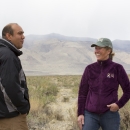
Click to enlargeRENO, NEVADA… The U.S. Fish and Wildlife Service (Service) announced today that Edward (Ted) Koch (pronounced "cook") has been selected as the new State Supervisor for the Nevada Fish and Wildlife Office. Koch will be supervising all the Service’s ecological services programs in Nevada which includes offices located in both Reno and Las Vegas.

Koch has 23 years of experience with the Service, most recently as the Service’s Bull Trout Coordinator in Boise, Idaho. Koch has a B.S. in Environmental Biology from Southern Connecticut State University and an M.S. in Zoology from Idaho State University.

“Ted brings a wealth of knowledge and experience in wildlife conservation to the Nevada Fish and Wildlife Office,” said Pacific Southwest Region Director Ren Lohoefener. “I had the great pleasure of working with Ted on Idaho and Pacific Northwest issues and I know he will help us work with the State, Tribes, and all other partners to resolve the conservation issues we face today and tomorrow in Nevada and the Pacific Southwest.” Photo Caption: Edward (Ted) Koch. Credit: USFWS
News Release

   
  U.S. Fish and Wildlife Service Determines Northern Leatherside Chub Does Not Warrant Protection Under the Endangered Species Act
October 11, 2011
Click to enlargeThe U.S. Fish and Wildlife Service (Service) announced today that it has completed a status review, also known as a 12-month finding, of the northern leatherside chub, and concluded it does not warrant protection under the Endangered Species Act (ESA). We made this finding after a thorough review of all the available scientific and commercial information regarding the status of the northern leatherside chub and threats to the species.

The northern leatherside chub (Lepidomeda copei) is a small desert fish in the minnow family that occurs in northern Utah and Nevada, southern and eastern Idaho, and western Wyoming. Current populations are found in the Bear, Snake, and Green River drainages. Its common name comes from the leathery appearance created by small scales on a trim, tapering body. Northern leatherside chub occur in small desert streams between elevations of approximately 4,100 and 9,000 feet, with low to moderate velocities. They have relatively broad diets, eating items in both the stream drift and the substrate, with insects comprising a large portion of diet
. Photo Caption: Northern leatherside chub. Credit: Paul Chase / Uinta-Wasatch-Cache National Forest, USFS
News Release
Frequently Asked Questions
   
  Endangered Species Act Protection for Northern Leopard Frog is Not Warranted
October 4, 2011
Click to enlargeThe northern leopard frog does not warrant federal protection as a threatened or endangered species, the U.S. Fish and Wildlife Service (Service) announced today. The announcement is the result of an evaluation of the status of the northern leopard frogs its 19-state western range and throughout the species’ entire range.

The Service was petitioned in 2006 to add the western U.S. population of the northern leopard frog to the list of threatened species protected under the Endangered Species Act. Under the Endangered Species Act, animal populations that are discrete, significant and threatened can be considered for protection as a “distinct population segment” (DPS). Genetic data analyzed indicates that, while there are genetic differences among leopard frogs, the populations are not markedly separate. Therefore, the western U.S. populations do not qualify as a DPS.
Photo Caption: Northern leopard frog. Credit: Laurie Averill-Murray
News Release
Frequently Asked Questions
About the Northern leopard frog
   
  Four Great Basin Butterflies May Warrant Protection Under the Endangered Species Act
October 3, 2011
Click to enlargeThe U.S. Fish and Wildlife Service (Service) today announced that four butterfly species native to the Great Basin of Nevada may warrant federal protection as a threatened or endangered species under the Endangered Species Act (ESA).

Today’s decision, commonly known as a 90-day finding, is based on scientific information about the species provided in a petition requesting protection of the species under the Endangered Species Act (ESA) and in the Service’s files. The Service will now undertake a more thorough status review of the butterflies – the Baking Powder Flat blue butterfly (Euphilotes bernardino minuta), bleached sandhill skipper (Polites sabuleti sinemaculata), Steptoe Valley crescentspot (Phyciodes cocyta arenacolor), and White River Valley skipper (Hesperia uncas grandiosa) – to determine whether to propose adding the species to the Federal List of Endangered and Threatened Wildlife.
Photo Caption: Butterfly. Credit: USFWS
News Release
Federal Register
Frequently Asked Questions
   
  32 Species of Springsnails Warrant Review for Possible Protection Under the Endangered Species Act
September 12 , 2011
Click to enlargeLAS VEGAS — The U.S. Fish and Wildlife Service (Service) today announced it will conduct an in-depth status review of 32 Great Basin and Mojave Desert springsnails to determine if any or all of them warrant federal protection as a threatened or endangered species under the Endangered Species Act (ESA).

Today’s decision, commonly known as a 90-day finding, is based on scientific information in the Service’s files and provided in a petition requesting the listing of 42 species of Great Basin and Mojave Desert springsnails in Nevada, Utah, and California as threatened or endangered with the designation of critical habitat under the ESA.
Photo Caption: Springsnails. Credit: USFWS
News Release
Federal Register
Frequently Asked Questions


Last updated: December 27, 2011