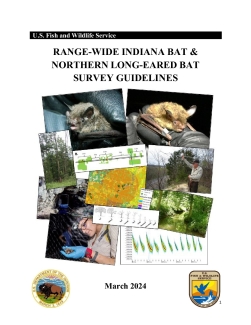
Range-wide Indiana Bat and Northern Long-eared Bat Survey Guidelines

UPDATES: 

(March 20, 2026) 

2026 Survey Guidelines Document

Surveyors should follow this new version of the bat survey guidelines for planning presence/probable absence surveys. The document, as well as several other related documents, can be found below.

The 2026 version includes a number of changes, including:

  • Streamlined Structure: The 2026 Survey Guidelines document has been reduced by nearly half of the size from previous versions, with the goal of improving flow, clarity and navigation for users. 
  • DNA Collection: Inclusion of new instructions for DNA sample collection to help facilitate species identification, while reducing the need for intrusive wing biopsies.
  • Western Species Identification: New language was added related to identification of western Myotis bat species. 
Reminder for Acoustic Surveys: Review approved software list BEFORE submitting study plan   

The Survey Guidance Team tests new software programs and new versions of currently approved programs and will continue to update the list of approved software on the Automated Acoustic Bat ID Software Programs page. Before submitting your study plan, please review the list of approved software programs and all associated footnotes if you are conducting acoustic presence/probable absence surveys in 2026.

Background

The Indiana bat (Myotis sodalis) was originally listed as endangered under the Endangered Species Preservation Act of 1966 (32 FR 4001, March 11, 1967), and continues to be listed as endangered under the Endangered Species Act (ESA) of 1973, as amended. In 2015, the U.S. Fish and Wildlife Service (Service) listed the northern long-eared bat (Myotis septentrionalis) as threatened under the ESA and in 2022 the Service reclassified the northern long-eared bat as an endangered species. This survey protocol provides the Service's recommended guidance on survey methods and outlines additional reporting requirements for surveyors for Indiana bat and northern long-eared bat.

Range-wide Indiana Bat/Northern long-eared bat Survey Guidelines:

Fillable Forms and Datasheets

Other Bat Survey-related Information:

Author(s)
Image
Grayscale U.S. Fish and Wildlife Service logo
Fish and Wildlife Biologist
Ecological Services
Expertise
Endangered Species Act,
Northern long-eared bat,
Karner blue butterfly
Bloomington,MN
Publication date
Type of document
Protocol
Protocol
Media Usage Rights/License
Public Domain
Program
A rocky shoreline of a river. The water is calm. Mist and green branches line the river.
The Ecological Services Program works to restore and protect healthy populations of fish, wildlife, and plants and the environments upon which they depend. Using the best available science, we work with federal, state, Tribal, local, and non-profit stakeholders, as well as private land owners, to...
Close up of a California condor. Its pink featherless head contrasts with its black feathers.
We provide national leadership in the recovery and conservation of our nation's imperiled plant and animal species, working with experts in the scientific community to identify species on the verge of extinction and to build the road to recovery to bring them back. We work with a range of public...
Species
Cluster of roosting bats.

The Indiana bat is a medium-sized Myotis, closely resembling the little brown bat (Myotis lucifugus) but differing in coloration. Its fur is a dull grayish chestnut rather than bronze, with the basal portion of the hairs on the back a dull-lead color. This bat's underparts are pinkish to...

FWS Focus