This step-by-step guide will walk you through the process of project screening and--when appropriate--obtaining project review from the U.S. Fish and Wildlife Service's (Service) New Jersey Field Office (NJFO). This guide is valid only for projects proposed in New Jersey. Please be sure to review and carefully follow all six (6) steps listed below.
What is consultation?
Section 7 Section 7 Section 7 Consultation
The Endangered Species Act (ESA) directs all Federal agencies to work to conserve endangered and threatened species and to use their authorities to further the purposes of the Act. Section 7 of the Act, called "Interagency Cooperation," is the mechanism by which Federal agencies ensure the actions they take, including those they fund or authorize, do not jeopardize the existence of any listed species.
Learn more about Section 7 (a)(2) of the Endangered Species Act (ESA) requires Federal agencies to consult with the Service to ensure that actions they fund, authorize, permit, or otherwise carry out will not jeopardize the continued existence of any listed species, or result in the destruction or adverse modification of designated critical habitats. Federal agencies ARE NOT required to contact the Service if a proposed action will have no effect on listed species. However, Federal agencies ARE REQUIRED to initiate consultation with the Service if a proposed action may affect one or more listed species or designated critical habitat.
What is technical assistance?
The NJFO provides review of non-Federal actions that may affect federally listed species or their habitats as technical assistance under the Endangered Species Act (ESA). Technical assistance helps:
avoid or minimize adverse effects to listed species;
avoid unintentional violations of the ESA Section 9, which prohibits unauthorized take of listed wildlife;
determine if a Section 10 permit and a Habitat Conservation Plan are needed; and
ensure compliance with New Jersey land use regulations.
Through our Conservation Planning Assistance program, the NJFO also provides technical assistance reviews of proposed actions (both Federal and non-Federal) that are likely to impact wildlife resources other than federally listed species. These other wildlife resources include migratory fish and birds, wetlands, National Wildlife Refuges, and the Coastal Barrier Resources System.
When does the NJFO review projects?
The NJFO reviews proposed projects under certain circumstances, for example when:
a Federal permit, license or other authorization is required (e.g., an Army Corps permit), Federal funding will be used in project implementation, and/or a Federal agency will carry out the project;
a State freshwater wetland permit is required in a municipality that is known to support federally listed species;
a State freshwater wetland permit is required and will involve Federal review (e.g., wetland fill over 5 acres, channelization of over 500 feet of stream);
an applicant/project proponent or authorizing/implementing government agency requests Service input as technical assistance; or
proposed activities may affect a federally listed species, or may impact other wildlife resources such as a National Wildlife Refuge, bald eagles, other migratory birds or fish, and/or are located in a unit of the Coastal Barrier Resources System.
Specific to the Endangered Species Act (ESA), Service review is REQUIRED under the following two circumstances:
If a project that involves Federal funding or Federal authorization may affect a federally listed species, then consultation with the Service is required under Section 7 of the ESA.
OR
If a non-Federal project may result in take of a federally listed species, then technical assistance should be requested from the Service to determine if a permit and a Habitat Conservation Plan are required under Section 10 of the ESA.
Step by Step Instructions for Project Review
STEP 1: Delineate the Action Area of the Project
The action area action area All areas to be affected directly or indirectly by the federal action and not merely the immediate area involved in the action.
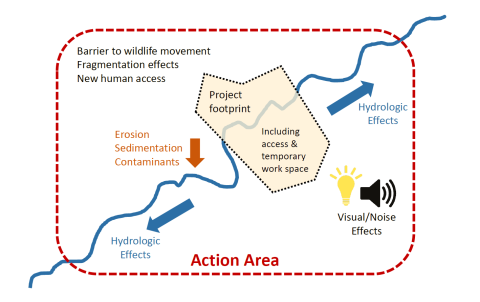
Learn more about action area of a proposed project is defined by regulation as all areas to be affected directly or indirectly by the Federal action and not merely the immediate area involved in the action (50 CFR Section 402.02). This analysis is not limited to the "footprint" of the action nor is it limited by the Federal agency's authority. Rather, it is a biological determination of the reach of the proposed action on listed species.
This diagram shows how an action area encompasses the project footprint and any area impacted by the effects of the project.
In New Jersey, the Service recommends that project proponents delineate the action area to include all of the following that may apply on a permanent or temporary basis:
the entire limits of disturbance, including proposed access routes and temporary work spaces as well as areas of permanent impacts
at least 1 mile upstream and downstream of activities that may impound stream or river flow
at least 1 mile downstream of in-stream work
at least 1 mile downstream of new ground or surface water discharges of any kind (e.g., stormwater, wastewater, cooling water)
at least 1 mile downstream where sediment-generating activities are proposed within 500 feet of a stream or river
at least 1 mile downstream where pollutants (e.g., petroleum products, pesticides, herbicides) will be used or stored within 500 feet of a stream or river
at least 1 mile downstream of new or increased surface water with drawls
the entire area in which ground water tables may be affected (e.g., draw down, reversal of flow) as a result of a new or increased ground or surface water withdrawls
all wetlands and waterbodies down-gradient of vegetation clearing
all wetlands and waterbodies down-gradient of sediment-generating activities
all wetlands and waterbodies down-gradient of proposed new impervious surface
all areas likely to experience increased erosion as a result of project activities
all areas in which project activities will be audible or visible to wildlife, including noise and lighting effects
all areas which may become inaccessible to wildlife as a result of new or enlarged barriers to movement (e.g. roads, rail lines, dams)
all areas which may become unsuitable to wildlife as a result of indirect effects of habitat fragmentation (e.g., "edge effects")
all areas in which wildlife prey resources (e.g., invertebrates) may be indirectly impacted by project activities (e.g., through drift of placed sediments, pesticide overspray)
all areas subject to new or increased public, recreational, or other human uses -- either legal or illegal -- as a result of new access routes or infrastructure included in the project plans
all areas where suitable or optimal habitat features may be precluded or delayed in forming due to project activities
all areas affected by reasonably foreseeable future actions that would not occur without ("but for") the project is currently being proposed
STEP 2: Obtain a Species List
Visit the Service's Information, Planning, and Conservation System ( IPaC IPaC Information for Planning and Consultation (IPaC) is a project planning tool that streamlines the USFWS environmental review process
On the "Define area" screen, draw the action area of the proposed project.
View, print, and/or download the preliminary and/or official species list report, as well as information on other wildlife resources in the vicinity.
STEP 3: Determine if Service Review is Needed
If the proposed project is a communication tower or antenna, review our Communication Towers and Antennas document. For all other project types, follow the instructions in the rest of this section (Step 3).
If IPaC returns a result of "There are no listed species found within the vicinity of the project," then project proponents can conclude the proposed activities will have no effect on any federally listed species under Service jurisdiction. Attach this No Effect Letter to the dated IPaC species list report for your records and proceed to Step 6 on this page to protect other wildlife resources.
If IPaC indicates that any federally listed species may occur in your action area, then use these Project Screening Questions to determine if project-specific review is needed.
Due to limited staff, NJFO is unable to provide project-specific concurrence with a no effect determination based on the IPaC species list report and Project Screening Questions. You can use the No Effect Letter (attached to the dated IPaC species list report and supporting documentation) to document the NJFO's policy of NOT providing concurrence with a no effect determination. Proceed to Step 6 on this page to protect other wildlife resources.
NOTE: No correspondence with the Service regarding federally listed species is necessary for no effect projects. However, the Service SHOULD be contacted if our general recommendations to protect other wildlife resources cannot be implemented.
Note that under the ESA, a species list is valid for only 90 days. New occurrences of listed, proposed, and candidate species and potentially suitable habitat are discovered periodically. Therefore, the NJFO recommends that you visit this web site at regular intervals during project planning and implementation for updates to species lists and information.
Please note that consultation/technical assistance with the Service should be coordinated with the New Jersey Division of Land Use Regulation for any project that will require authorization under the State's Freshwater Wetlands Protection Act (see Memorandum of Agreement).
Notes about the New Jersey Landscape Project:
The Landscape Project is an ongoing effort by the New Jersey Endangered and Nongame Species Program to "protect New Jersey's biological diversity by maintaining and enhancing imperiled wildlife populations within healthy, functioning ecosystems." Protection of mapped habitats is reflected in New Jersey's Land Use Regulations.
Landscape Project maps do not include habitat for federally or State-listed plants. Information regarding State-rare plants and natural communities is available from the New Jersey Natural Heritage Program.
Habitats mapped on the Landscape Project do not constitute Critical Habitat designated under the federal Endangered Species Act.
Presence or absence of habitat for federally listed species on the Landscape Project does not determine whether consultation or technical assistance with the NJFO is necessary under the federal Endangered Species Act (see Overview section at the top of this page).
Landscape Project maps are not produced by the Service. Questions regarding the Landscape Project should be directed to the New Jersey Endangered and Nongame Species Program.
STEP 4: Submit Project Information
The NJFO strives for paperless project reviews. After following all the steps on this page, please use this email address to submit all new requests for project review.
Please include the name of the project in the subject line of the email.
Please do not mail a paper copy.
If you have supporting materials that cannot be emailed, note that in your incoming request and a biologist will follow up with you.
Please DO NOT email general correspondence or inquiries to the above address -- new project review requests only.
Please DO NOT email new project review requests to individual staff biologists.
Once a project review is in progress, follow-up emails can be exchanged directly with the assigned biologist.
Please be sure to follow Steps 1, 2, and 3 on this page before requesting ESA consultation or technical assistance. If you have determined that you need to consult with the NJFO, or require technical assistance, you can assist us in expediting your request by providing the specific information listed below about the proposed project activities and project site. We understand that some of the information requested below may not be available at the time you make your request (e.g., detailed project plans); however, please provide as much information as possible to expedite our review. Due to staffing constraints, submissions lacking necessary project information will be returned via email.
INFORMATION TO INCLUDE WITH REQUESTS FOR PROJECT REVIEW:
The name of the project or property, including municipality, county, and Block and Lot number.
UPDATED 4/19/23! The location of the subject property and extent of any project-related activities or discharges clearly delineated on a recent aerial or satellite map with major roads and landmarks labeled. Please provide the map(s) at a scale depicting at least a 1-mile radius surrounding the subject property and any affected areas.
UPDATED 4/19/23! An ESRI-compatible GIS layer (e.g.,shapefiles, including the projection) depicting the project route(s) or area(s). This should be the same GIS layer that was uploaded to--or generated by--IPaC. [To retrieve a GIS layer of the action area as drawn in IPaC, users should follow these steps: (a) After entering a project into IPaC, go to the "Project Home" page. The page displays a map widget that shows the project area. (b) Click the button, located in the top right corner of the map widget, to expand the map to fullscreen. (c) Click the "download shapefile" button on the left hand side of the page, which will export a zipped folder containing a shapefile of the project action area boundary, as drawn in IPaC.]
The name(s) of any Federal agency authorizing, providing funding for, and/or carrying out the proposed project. If the project is non-Federal, please indicate this in your request for technical assistance.
Indication whether a State Freshwater Wetland permit will be required, and a list of any other non-Federal authorizations being sought.
A brief description of the proposed project (e.g., residential, commercial), including proposed utilities, stormwater management, and project plans if available. Include expected start date and duration of project activities.
A description of the natural characteristics of the property and surrounding area (e.g., forested areas, freshwater wetlands, open waters, and soils). Additionally, please include a description of surrounding land use (e.g., residential, agricultural, or commercial) and a description of the area to be impacted by the proposed project, including trees and other vegetative cover types to be removed.
Pictures of the project area along with project plans or a map indicating the orientation of the pictures.
A copy of any field surveys or habitat evaluations conducted.
NOTE: Contact the Service before conducting surveys for any federally listed wildlife (animal) species to obtain a list of recognized, qualified surveyors and to request concurrence with a draft survey work plan.
Indication of which federally listed species may be affected by the proposed activities, based on the IPaC species list report and the Project Screening Questions used under Step 2. Please attach a copy of the dated IPaC report.
Please DO NOT submit requests to review projects for which IPaC has returned a result of, "There are no listed species found within the vicinity of the project." (See Step 2.)
Please DO NOT submit requests to review projects for which ALL species given in the IPaC report are "no effect" or "complies with the 4(d) rule" as per the the Project Screening Questions. (See Step 2.)
For projects where IPaC has returned a result of Indiana bat, please indicate whether or not tree clearing is proposed. If tree clearing is proposed, describe the species, size (diameter at breast height), and number (or acres) of trees proposed for removal; and indicate whether clearing of tress >5 inches in diameter at breast height will be seasonally restricted as follows, making reference to the Bat Municipality List.
In municipalities with hibernation occurrence: April 1 - November 15.
In municipalities with maternity occurrence: April 1 - September 30.
In municipalities with both hibernation and maternity occurrence: April 1 - November 15.
In areas of potential occurrence (i.e., all areas returned by IPaC but not on the bat municipality list): April 1 - September 30.
For projects where IPaC has returned a result of Northern long-eared bat, indicate whether or not the project occurs in a municipality with known hibernacula or maternity roost trees (Bat Municipality List).
For projects involving any Federal funding or Federal authorization that may affect the Northern long-eared bat, the Federal action agency must notify the NJFO at least 30 days before starting the action. Please use the 4(d) Rule Streamlined Consultation Form (**coming soon**).
Proposed conservation measures to avoid impacts to federally listed species.
Your assessment of impacts to federally listed threatened and endangered species from proposed project activities, and your preliminary determination of whether each federally listed species IS or IS NOT likely to be adversely affected.
Indication if the Service's recommendations to protect other wildlife resources will be implemented.
Your contact information including telephone number (with any extension), facsimile number, U.S. mailing address, and electronic mail address.
STEP 5: Coordinate with the Service
The NJFO strives to respond to all requests for informal Section 7 consultation on Federal projects, technical assistance requests for non-Federal projects, and public inquiries, within 30 days after all necessary information is received. Receipt of incomplete information may delay our response substantially.
Our response will have a control number in the upper left corner of the letter; please refer to this number during any subsequent correspondence.
For some projects, a Service biologist may contact you via telephone or email to request a site visit, additional project information, or refinement of the proposed conservation measures.
STEP 6: Protect Other Wildlife Resources
The Service recommends the following best practices to protect other wildlife resources, which are protected by various Federal and State laws. Please contact the NJFO if you require technical assistance in implementing these recommendations.
Seasonally restrict tree clearing from April 1 to August 31 to avoid injuring or killing nesting birds.
For proposed communication towers, follow the Service’s tower siting guidelines, and coordinate with the NJFO on structures over 200 feet tall.
For proposed wind turbines, require consistency with Service's wind turbine guidance and coordinate with the NJFO during project review.
For glass windows in existing buildings and proposed buildings two stories or less, adopt best practices to minimize bird collisions such as glass coverings, minimizing and down-shielding outdoor lights, and careful landscaping. For proposed buildings three stories or taller, coordinate with the Service during project review and follow best practices such as turning off indoor lights and using bird-friendly glass or glass coverings as recommended by the Fatal Light Awareness Program.
Avoid habitat fragmentation and barriers to wildlife movement, such as new roads or dams.
Avoid the use of polluting materials [e.g. chromated copper arsenate (CCA), ammoniacal copper zinc arsenate (ACZA), alkaline copper quaternary ammonium (ACQ), wolmanized copper azole (CA-B and CA-C), and acid copper chromate (ACC)] in aquatic environments supporting shellfish habitat.
Avoid impacts to sensitive wildlife areas such as habitats for State-listed species, vernal habitats, biodiversity priority sites, shellfish beds, and submerged aquatic vegetation.
You are exiting the U.S. Fish and Wildlife Service website
You are being directed to
We do not guarantee that the websites we link to comply with Section 508 (Accessibility Requirements) of the Rehabilitation Act. Links also do not constitute endorsement, recommendation, or favoring by the U.S. Fish and Wildlife Service.